Canmore Winter: Snow, Driving and What It Costs
A Canmore winter for people thinking of living here: sun exposure by neighbourhood, snow and cold snaps, heating costs, driving in the snow, what the Town expects of homeowners, and the upside that keeps people here.
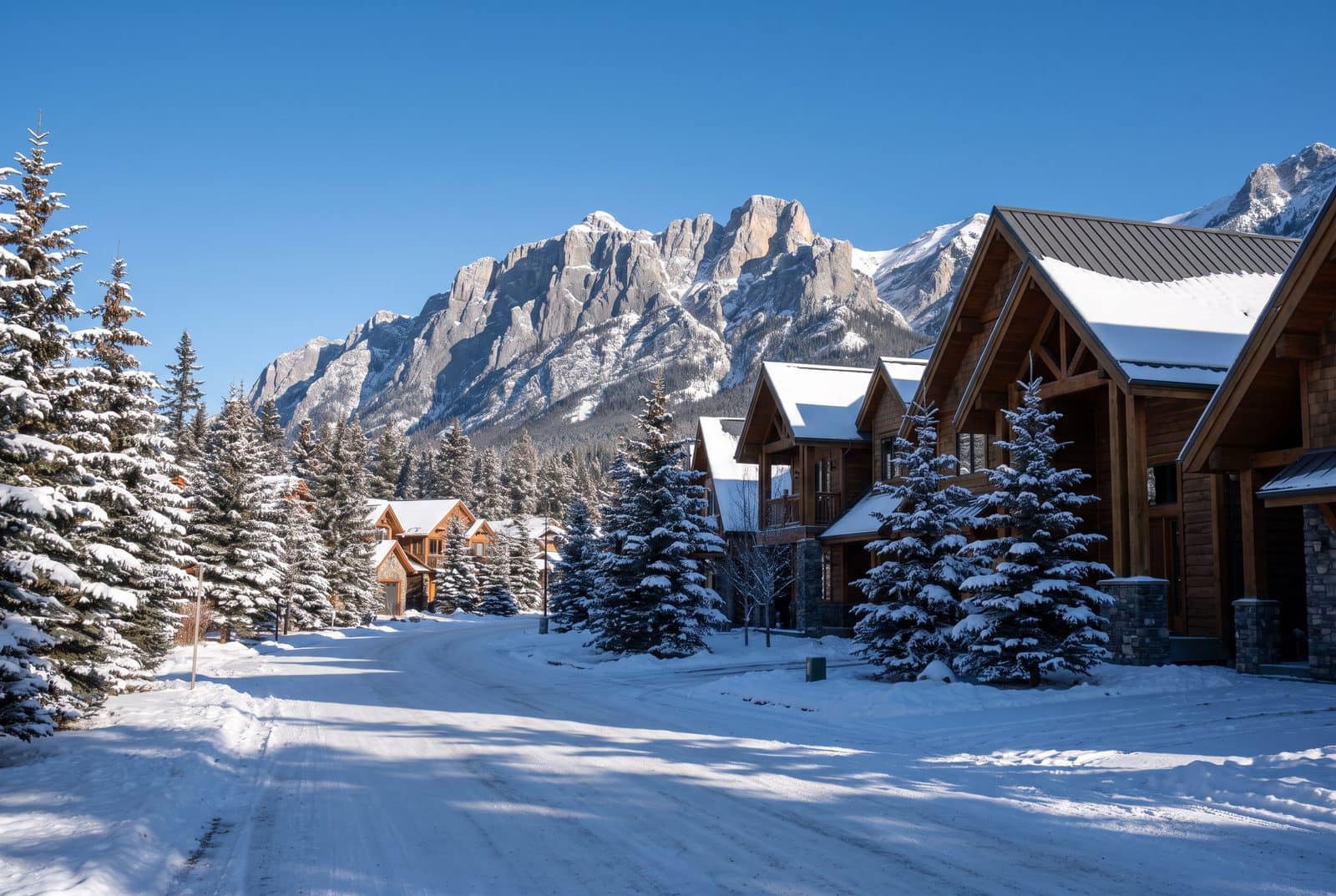
- Cold but dry and bright: January averages −8.5°C with a daily low of −13.5°C at the Banff station; cold snaps below −20°C come in stretches totalling about 23 days a year.
- About 184 cm of snow falls in a normal year, most of it in stretches; November is typically the snowiest month, and chinooks strip it away in days.
- Sun exposure varies more by street than by town: north-side benches keep the winter sun, south-side pockets under Ha Ling and the Rundle range lose it for weeks.
- Heating is the winter cost: expect natural-gas bills in a detached home to run several times the summer figure; utilities for an 85 m² home average about $389 a month year-round (Numbeo, June 2026).
- The upside is real: four ski areas within about an hour, the Nordic Centre in town, and more sunny days than the B.C. Side of the Rockies.
A Canmore winter is the thing visitors romanticise and residents plan around. It is long: late October to April, cold in stretches, dry, bright and, depending on which street you live on, either flooded with low sun or in shadow for weeks. The people who thrive here treat winter as the main season, not the price of summer. This guide covers what the climate data actually say, sun exposure by neighbourhood, snow, cold snaps and heating, driving and the Town’s expectations of homeowners, and the upside that keeps people in Canmore through their tenth February.
- January daily average
- −8.5°C
- Banff CS, 1991–2020 normals · high −3.5, low −13.5
- Annual snowfall
- ≈ 184 cm
- Banff CS, 1991–2020 normals
- Days below −20°C
- ≈ 23 / yr
- Banff CS, 1991–2020 normals
- Shortest day
- 7 h 54 min
- 21 December · WeatherSpark, Canmore
- Cold season
- 17 Nov – 25 Feb
- WeatherSpark definition, Canmore
- Utilities, 85 m² home
- ≈ $389 / mo
- year-round average · Numbeo, June 2026
Canmore winter: what the climate data say
Environment and Climate Change Canada publishes no 1991–2020 climate normals for the Canmore station, so the nearest long-record set is Banff CS at 1,397 m, about 25 km west; Canmore sits roughly 100 m lower and is typically a degree or two milder. On the 1991–2020 normals, January averages −8.5°C with daily highs of −3.5°C and lows of −13.5°C; July averages 14.7°C with highs of 22.5°C. Annual precipitation is 454 mm, of which about 184 cm falls as snow. Roughly 23 days a year drop below −20°C, and the station’s long-term extreme is −51.2°C, set in January 1950 (Environment and Climate Change Canada).
Two features make those numbers feel better than they read. The valley is dry, so −15°C here is more bearable than −5°C in a damp coastal city. And chinooks, warm westerly winds spilling over the Rockies, arrive several times a winter and can lift the temperature 15 degrees in a few hours, stripping snow from streets and south-facing slopes. The flip side is that WeatherSpark’s Canmore profile puts the cold season at three-plus months, from about 17 November to 25 February, and the shortest day at 7 hours 54 minutes of daylight.
Sun exposure by neighbourhood
This is the winter variable that matters most to a resident and least to a visitor. Canmore runs roughly east–west in a valley between the Fairholme and Rundle ranges. In December the sun barely clears the peaks to the south, so which slope you live on decides whether your living room gets three hours of direct sun or none.
| Area | Aspect | Winter sun | Notes |
|---|---|---|---|
| Silvertip | North side, south-facing | Best in town | High on the sunny side; snow melts off decks and driveways first |
| Eagle Terrace, Benchlands, upper Cougar Creek | North side, south-facing | Very good | Elevated lots with views of the Three Sisters |
| Downtown, South Canmore, Lions Park, Spring Creek | Valley floor | Moderate | Flat and walkable; sun arrives late and leaves early in December |
| Three Sisters, Homesteads | South side, north-facing | Variable | Open sections are fine; pockets under the Rundle range lose sun for weeks. It changes street by street, so check the specific address |
| Peaks of Grassi | South side, base of the Lawrence Grassi range | Least | Shaded for a stretch around the solstice; icier driveways, colder homes |
Aspects are qualitative and vary house by house; a tall tree or a neighbouring building changes everything. The Canmore sunny side versus shady side post goes street by street.
Buyers who view in June cannot see the shadow line. If you are looking between November and February, view at 2 to 4 p.m. And stand in the main living space. If you are looking in summer, ask a local REALTOR® which streets go dark, and look at the neighbours’ driveways in the listing photos: ice in April is a tell.
Snow and cold snaps
Snow arrives in earnest in late October or November, which is typically the snowiest month, and the base holds on north-facing streets until April, in practice the town sees a rhythm of storms and chinooks: 20 or 30 cm falls, is plowed and packed, then a warm wind clears the south-facing pavement in a couple of days while the shaded side stays white. Total annual snowfall of about 184 cm sounds like a lot; spread over six months with chinooks in between, it is manageable with a decent shovel and a snow-blower for a long driveway.
Cold snaps are the harder part. Two or three times a winter an Arctic high settles over the province and daytime temperatures sit at −20°C to −30°C for three to seven days. Those are the days furnaces fail, pipes in unheated garages freeze, cars refuse to start without a block heater and the trailheads empty. Residents keep a plug-in cord in the car, a backup heat source at home and the furnace serviced every autumn.
Heating and the winter cost of a home
Numbeo’s June 2026 estimate for basic utilities on an 85 m² home is about $389 a month averaged over the year. Winter is where the average hides the truth: natural-gas bills in a detached home with big windows and a cathedral ceiling run well above the July figure in December and January. No one publishes a Canmore-specific seasonal range, so the only reliable number is the property’s own: ask for twelve months of gas and electricity bills before you write an offer. Newer construction with good insulation, triple glazing and in-floor heat is markedly cheaper; a 1980s chalet is not. Condo owners pay heat through fees in many buildings, which is one reason a $600-a-month fee can be reasonable. The cost of living guide builds the full budget.
Things to check on a winter viewing or in the inspection: the age and service history of the furnace, whether the garage is heated, where the water shut-off is, the condition of the roof and eaves (ice damming is common on shaded roofs), and whether the driveway faces north.
Driving, tires and the highway
Inside town, winter driving is easy: streets are plowed, distances are short and Roam’s local routes 5C, 5T and 12 run free all year. The Trans-Canada to Calgary is the exception, closing several times each winter for multi-vehicle crashes on the open flats east of town, a 2019 series of pileups put about 40 vehicles in the ditch near Canmore (CBC). Winter tires are not legally required in Alberta but are the norm from October to April; a block heater matters on the cold-snap nights; and checking Alberta 511 before a Calgary trip is a habit worth forming on day one.
What the Town expects of homeowners
Owners and occupants must clear ice and snow from every sidewalk adjacent to their land within 48 hours of it forming or falling, and condominium corporations carry the same duty for condo land (Community Standards Bylaw 2022-16, sections 32 and 33). Miss it and the Town can do the work and add the cost plus a 10% administration fee to your tax roll. The Town itself plows to a three-tier standard: arterials, collectors, school and transit routes within 24 hours, the downtown core, industrial areas and pathways within 48 hours, and local roads, laneways and parking lots only as needed (Town of Canmore Snow and Ice Control Policy). Windrows across driveways are the resident’s problem. Most condo corporations contract snow removal, so check what the fees cover. Bear-resistant bins, roof-snow awareness and keeping gas meters clear of drifts round out the list.
The upside
The reason people stay is that a Canmore winter is a sport season, not a waiting room. The Canmore Nordic Centre’s cross-country trails are about five minutes from the town centre; Kananaskis puts Nakiska at roughly 35 minutes, Sunshine Village at about 45, and Lake Louise village at about 50 minutes, with Norquay the closest of the Banff hills. Fat-biking, ice climbing at the Junkyards and Grotto Canyon, skating on the ponds and backcountry skiing in Kananaskis are all local. The light is the other thing: dry air, low sun on snow, and far more clear days than the B.C. Side of the Rockies. The town gets busier around Christmas and February’s Family Day week, and quieter, cheaper and friendlier in between.
Buy the home you would want on 15 January, not 15 July. A south-facing deck in Silvertip or a walkable Lions Park bungalow near the rec centre gets used all winter; a north-facing unit with a summer view of the Three Sisters gets used in August and resented in December. Sun exposure shows up in resale, too, the sunny side sells faster in winter listings.
What this means if you’re buying
Winter is one of the four physical risks weighed in wildlife, wildfire and winter risks, alongside wildlife, wildfire and the creeks.
Put winter into the search criteria. Prioritise aspect and sun, a furnace and envelope you understand, a garage or parking that works at −25°C, and proximity to the highway if you commute. View in the afternoon between November and February if you can, and ask for the previous winter’s gas bills as part of your due diligence. Then compare the neighbourhoods that pass those tests on price and lifestyle using the neighbourhood guide. The sunny side costs more for a reason.
Everything else about settling in here, through a Canmore winter and the rest of the year, is in the living section.
Fifteen minutes with a local REALTOR®: sun exposure by street, heating costs by building type, and what to look for on a Canmore winter viewing. Free, no obligation.
If winter is the reason you are hesitating, moving to Canmore sets out the practical checklist for arriving before the snow.
Frequently asked
How cold does it get in Canmore in winter?
The Banff climate station, 25 km west and slightly higher than Canmore, records January daily averages of −8.5°C, highs of −3.5°C and lows of −13.5°C (1991–2020 normals). About 23 days a year drop below −20°C, usually in two or three multi-day cold snaps, and the long-term extreme is −51.2°C in January 1950. Canmore sits lower and is typically a degree or two warmer.
How much snow does Canmore get?
About 184 cm a year at the Banff station (1991–2020 normals), spread from October to May with November usually the snowiest month. Snow in town is often thinner than on the surrounding peaks because the valley is dry and chinook winds melt it, so a residential street can go from 30 cm to bare pavement in a week.
Which Canmore neighbourhoods get the most winter sun?
The ones on the north side of the valley facing south: Silvertip, Eagle Terrace, the Benchlands and the upper parts of Cougar Creek. The flat valley floor: downtown, South Canmore, Lions Park, gets moderate sun. Parts of the south side under the Rundle range and Ha Ling, including pockets of Peaks of Grassi and Three Sisters, lose direct sun for several weeks around the December solstice.
How much does it cost to heat a home in Canmore?
Numbeo’s June 2026 estimate for basic utilities on an 85 m² home is about $389 a month averaged over the year, the figure used in our Canmore cost of living breakdown. Winter is lumpier: natural-gas bills in a detached home with large windows run well above the summer figure in December and January, so ask the seller for twelve months of actual bills. Newer insulated builds are cheaper to run; older cathedral-ceiling homes are not.
Is driving in Canmore in winter difficult?
In town, no, streets are plowed, distances are short and the free Roam bus runs all winter. The Trans-Canada to Calgary is the issue: it closes several times a season for multi-vehicle crashes on the open flats. Winter tires from October to April, a block heater for the cold snaps and a habit of checking Alberta 511 before you leave are what residents do.
Do you have to shovel your sidewalk in Canmore?
Yes, within 48 hours. Section 32 of Canmore’s Community Standards Bylaw 2022-16 requires the owner or occupant of land next to a sidewalk to clear ice and snow from all adjacent sidewalks within 48 hours of it forming or falling; section 33 puts the same duty on the condominium corporation for condo land. If it is not done the Town can clear it and charge the cost plus a 10% administration fee to the tax roll.
- Environment and Climate Change Canada: Banff CS 1991–2020 climate normals
- WeatherSpark: Average weather in Canmore year-round
- Numbeo: Cost of living in Canmore (June 2026)
- CBC: Trans-Canada Highway shut down near Canmore after pileups
- Roam Transit: Fares
- Town of Canmore: Community Standards Bylaw 2022-16 (office consolidation)
- Town of Canmore: Snow clearing and the Snow and Ice Control Policy
- Kananaskis: Skiing and snowboarding in the Canadian Rockies
Keep reading

Tell us what you’re looking for and get a straight answer, usually the same day. Free, and no obligation.