Canmore Investment Property
Long-term rental, tourist home or hotel condo: the three routes into a Canmore investment property compared on legality, tax, financing and returns, how the Livability Tax treats investors, why affordable-housing units are off limits, and the honest risks.
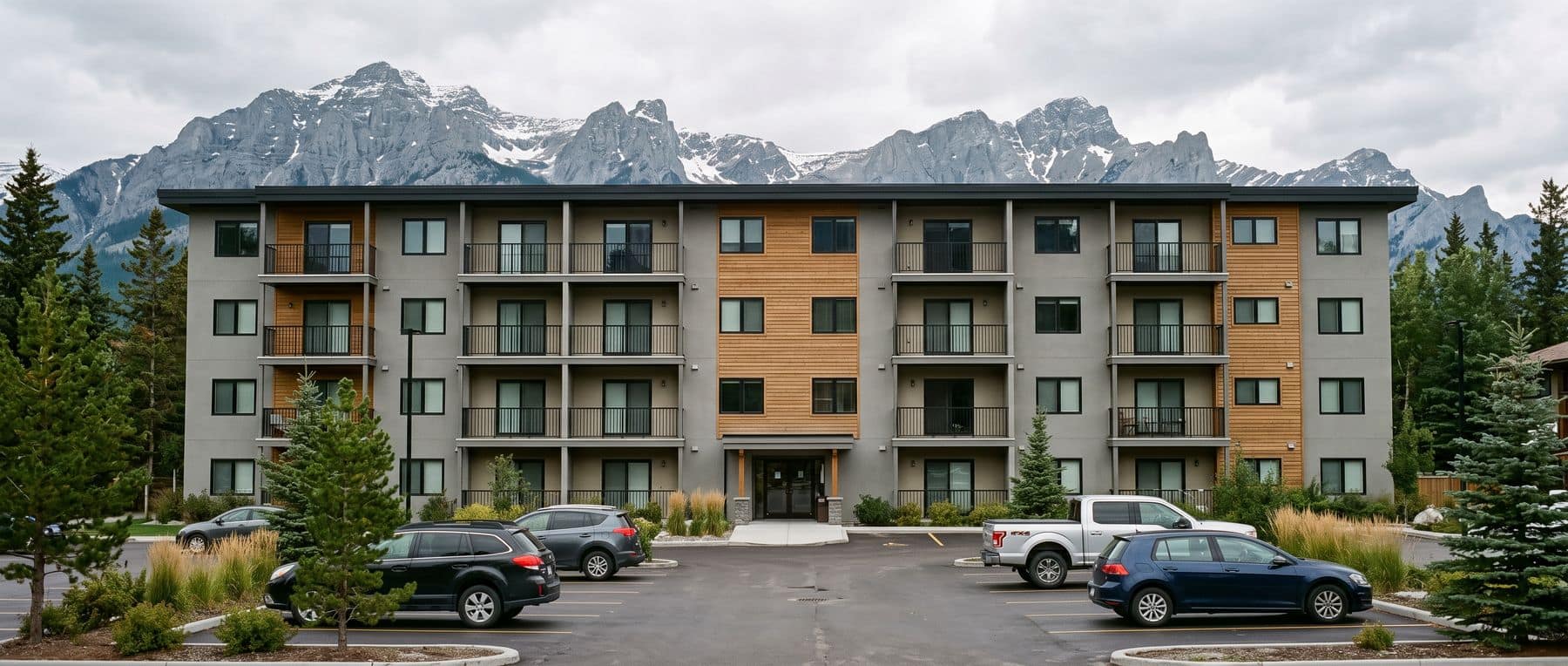
- Canmore has delivered price growth and near-zero rental vacancy, but at current prices gross yields are low; the case rests on appreciation and constrained supply rather than cash flow.
- Three legal investment routes: residential long-term rental (0.457% tax with a 183-day tenant), tourist home nightly rental (0.832%, 25–35% down), or hotel condo (0.957%, rental pool).
- The Livability Tax does not touch a long-term rental or any property with an Alberta resident on title; it adds about 0.377% of assessed value to a non-Albertan’s empty second home.
- Perpetually Affordable Housing and Vital Homes units require a qualifying owner-occupier, investors cannot buy them.
- Risks: 700–1,075 new units coming in Three Sisters Village Phase 1, regulatory change in short-term rentals, 2026 inventory up sharply, and condo special assessments.
Whether a Canmore investment property makes sense depends on which of three very different things you mean: a residential home rented to a tenant, a tourist-home unit rented by the night, or a hotel condo in a rental pool. They are taxed differently, financed differently, regulated differently and, since the Town’s 2025 and 2026 rule changes, priced differently. This page compares them honestly, explains how the Livability Tax treats each, sets out why affordable-housing units are not available to you, and lists the risks that the brochures leave out.
Is a Canmore investment property worth it?
The case for: prices rose through 2024 and 2025 while sales volume fell (483 sales in 2025, down 4% from 504), which is a market absorbing higher prices rather than rejecting them; supply is physically constrained by mountains, wildlife corridors and Banff National Park; Banff’s need-to-reside rule sends park demand to Canmore; 26% of properties are already owned by people who live elsewhere; and rental vacancy has been near zero with a 2023 living wage of $38.80 an hour (2023, the last year Canmore participated), the highest in Alberta.
The case against: at an $814,000 condo average and a $2.15 million detached average (2025), gross rental yields are thin, and a long-term rental in Canmore at 25% down will usually not cover its own mortgage, fees and tax; the tourist-home route is a fixed, regulated pool taxed at nearly double the residential rate; 700–1,075 new units are coming in Three Sisters Village Phase 1; and inventory has rebuilt from the 2021–22 lows, which is good for buyers and less good for anyone hoping to sell into scarcity.
Our conclusion, which the longer analysis argues in detail: Canmore rewards investment-property owners who would want the property anyway and can hold it, and punishes anyone who needs it to pay for itself from day one.
The three kinds of Canmore investment property
| Residential, long-term rental | Tourist home, nightly rental | Hotel condo (visitor accommodation) | |
|---|---|---|---|
| Legal nightly rental | No | Yes, with a $150/yr licence per unit | Yes, via the hotel pool |
| Can you use it yourself | Between tenancies | Yes | Only as a guest, subject to pool rules |
| 2026 Town tax rate | 0.457% with a tenant 183+ days or an Albertan on title; 0.833% otherwise | 0.832% regardless of use | 0.957% |
| Typical down payment | 20% (rental) | 25–35% (lender practice) | Often 35% or more, and fewer lenders will look at it |
| Purchase price | Base | 20–30% premium | Often lowest per square foot |
| GST on purchase | No (resale) | Usually no (resale) | Often yes, treated as a commercial supply; confirm the GST treatment of the specific unit with your accountant |
| Management | Self or property manager | Platform plus manager or self | Hotel operator, fixed split |
| Income character | Steady, monthly, no rent control in Alberta | Seasonal; ADR ≈ $302–334, occupancy ≈ 58–80% (2025–26) | Pool share, net of operator |
| Liquidity at resale | Widest buyer pool | Narrower, premium-paying pool; shrinking supply | Narrowest |
Canmore rental property: the long-term route
Any residential property can be rented long-term, and a tenant who lives there 183 or more days a year, including a 60-day continuous stretch, makes it a primary residence for the Livability Tax, so it pays the standard 0.457% rate. Alberta’s Residential Tenancies Act has no rent control, and demand from a workforce paid Canmore wages against Canmore rents is persistent. CMHC’s Rental Market Survey does track Canmore’s purpose-built stock, and in October 2025 average rents were $1,858 for a one-bedroom, $2,438 for a two-bedroom and $3,676 for three bedrooms or more, $2,319 across all unit types. That survey covers purpose-built rentals only, so asking rents on a condo with a parkade stall and a mountain view usually sit above it; ask a local REALTOR® what comparable units are actually letting for.
The arithmetic: at the 2025 apartment-condo average of $814,000 (canmorealberta.com) and 25% down, mortgage, condo fees and tax will exceed rent in most buildings in 2026, so the long-term route is an appreciation play with a tenant covering part of the carry, not a cash-flow investment. Where it works best is the older townhome and condo stock with low fees, and properties bought partly for future personal use. Where the personal use is the whole point, renting versus owning a vacation home here compares the two. Long-term rental investing in Canmore works through examples.
Tourist homes and short-term rental returns
The nightly-rental route is covered in depth on the tourist homes page. For comparison purposes:
- Average host revenue
- ≈ $68K–96K / yr
- 2025–26, three data vendors
- Average daily rate
- ≈ $302–334
- 2025–26
- Tourist-home tax, 2026
- 0.832%
- of assessed value, ≈ $7,490 on $900K
- Down payment
- 25–35%
- typical lender requirement
From gross revenue subtract platform and management fees (full-service management commonly takes somewhere between a fifth and a third of revenue, and there is no published Canmore benchmark, so get two or three quotes in writing), cleaning, utilities, STR insurance, condo fees and the tourist-home tax; then financing. The tourist-home ROI calculator does this with your own inputs and reports cash flow, cap rate and break-even occupancy. Since 11 March 2025 no residential property can be converted to tourist-home use, while owners can convert to residential fee-free until 31 December 2026, so outside Silvertip’s STR districts and Three Sisters Village the pool only shrinks, supportive of the premium, and a reminder that the rules can change.
Hotel condos
Visitor-accommodation units on Bow Valley Trail and downtown are operated by a hotel under a rental pool: the operator books, cleans and maintains, and owners receive a share. They cannot be lived in, permanent residence is prohibited, and they pay the 2026 non-residential rate of 0.957%, the same class as Canmore commercial real estate. Purchases usually attract GST as a commercial supply, financing is limited to a few lenders at higher down payments, and your return depends on the operator’s performance and the pool agreement. As an investment property they are the least work and the least control. Hotel condos in Canmore covers the mechanics.
How the Livability Tax treats investors
The Livability Tax is the Town’s higher rate on residential dwellings that are not a primary residence. For 2026 it is built into the “Residential” rate of 0.833% against 0.457% for a primary residence, about 0.377% of assessed value, and provincial legislation exempts any property owned wholly or partly by an Alberta resident.
| Scenario | Livability Tax? | 2026 rate |
|---|---|---|
| Residential unit, tenant living there 183+ days | No, occupied | 0.457% |
| Residential unit, empty or weekend use, Albertan on title | No, exempt | 0.457% |
| Residential unit, empty or weekend use, no Albertan on title | Yes | 0.833% |
| Tourist home, any use | Not applicable, separate class | 0.832% |
| Hotel condo | Not applicable, non-residential | 0.957% |
Note the near-identical 2026 rates for a tourist home and a non-Albertan’s non-primary residential unit. The primary-residence declaration is due 31 December every year and failure to file means the higher rate automatically. The Livability Tax guide has the rules; the property tax calculator has the numbers.
None of them work in Canmore. A condo at the 2025 average of $814,000 would need to rent for $8,140 a month to meet the 1% rule; it will not. Investors who apply Calgary or Edmonton heuristics here either overpay for yield that does not exist or walk away from an appreciation market for the wrong reason. Use the actual numbers: fees, tax class, financing, and decide on those. Why the 2% rule fails here.
What you cannot buy: PAH and Vital Homes
Canmore Community Housing’s Vital Homes ownership program, what most people still call Perpetually Affordable Housing, or PAH, is not available to investors. Buyers must be Canadian citizens or permanent residents who qualify through Canmore employment (30 hours a week for a licensed Canmore business for at least six months), employment plus 12 months’ residency, or five years of residency; gross household income must be $250,000 or less; the home must be the owner’s primary residence; and resale prices are held down by an inflation-indexed formula. If a listing is a PAH or Vital Homes unit, it is for a qualifying resident, and its price says nothing about the open market. The Canmore first-time home buyer guide explains the program for those who do qualify.
The honest risks
- Constrained land supply and a national park next door; Banff’s ownership rule adds demand
- Prices rose through 2024–25 while volume fell; the market absorbed higher prices
- Near-zero long-term rental vacancy and the highest living wage in Alberta
- Fixed and shrinking tourist-home pool supports the premium on eligible units
- No land transfer tax, no rent control, and Albertan owners exempt from the Livability Tax
- Thin gross yields at current prices; most long-term rentals do not cover their carry at 25% down
- 700–1,075 new units coming in Three Sisters Village Phase 1, with 400+ rental units: new supply on the low end
- Short-term rental rules changed in 2024, 2025 and 2026; assume they can change again
- Inventory has rebuilt from the 2021–22 lows; more choice for buyers
- Condo special assessments, insurance costs and, in parts of Three Sisters, undermining reports on title
- The federal foreign-buyer ban runs to 1 January 2027, limiting one source of buyers at resale
Older, low-fee townhomes and condos bought with a large down payment by owners who will use them in a few years; and tourist-home units in the handful of buildings with low fees and a long, licensed rental history. What does not work is a new premium unit at 25% down that needs 80% occupancy to break even.
What this means if you’re buying
Decide which kind of Canmore investment property you are actually buying: a long-term rental (residential, 0.457% with a tenant, appreciation play), a nightly-rental business (tourist home, 0.832%, 25–35% down, verify the designation) or a hotel-pool interest (0.957%, GST, operator risk). If what you are weighing is a business with premises rather than a property, business for sale in Canmore covers that transaction. Put an Albertan on title if one is available to you and the lawyer agrees. Run real fees and the correct tax class through the Canmore calculators before you look at photographs. And be honest about the horizon. Canmore has rewarded patient owners and disappointed anyone who needed it to pay for itself in year one.
Use the ROI calculator with real ranges, then book a free 15-minute call with a local REALTOR® to check which buildings and tax classes actually fit your plan.
Frequently asked
Is Canmore real estate a good investment?
It has been a good store of value. Prices rose through 2024 and 2025 while sales slowed, and supply is physically constrained by mountains, corridors and a national park. It is a poor cash-flow investment at today’s prices: a condo at the 2025 average of $814,000 rented long-term rarely covers its mortgage, fees and tax at 25% down. The honest case is appreciation, scarcity and personal use, with rental income offsetting rather than paying the cost.
Can I buy a Canmore rental property and rent it long-term?
Yes, any residential property. Demand is strong. Canmore’s living wage was $38.80 an hour (2023, the last year Canmore participated), the highest in Alberta, and rental vacancy has been close to zero. A tenant living there 183 or more days a year exempts the property from the Livability Tax. Alberta’s Residential Tenancies Act has no rent control. Budget realistically for condo fees and property tax at 0.457% of assessed value.
Do investors pay Canmore’s vacancy tax?
Only on properties that are not a primary residence and have no Alberta-resident owner on title. A long-term rental with a tenant living there 183+ days a year is exempt; a property owned wholly or partly by an Albertan is exempt by 2026 provincial legislation; tourist homes and hotel condos are in separate tax classes and pay their own higher rates regardless. The December 31 declaration is required in every case.
Can investors buy Perpetually Affordable Housing in Canmore?
No. Vital Homes and PAH ownership units through Canmore Community Housing are limited to Canadian citizens or permanent residents who qualify through Canmore employment or long-term residency, with gross household income of $250,000 or less; the home must be lived in, and resale prices are capped by a formula. They are an entry route for residents, not an investment product.
What is the cap rate on a Canmore tourist home?
It depends entirely on the unit, the building’s fees and how it is managed. Market data gives average host revenue of $68,000–96,000 a year for 2025–26; from that come platform and management fees, cleaning, utilities, insurance, condo fees and tourist-home tax at 0.832% of assessed value. Run a specific unit’s statements through our ROI calculator rather than relying on a market-wide figure.
Are hotel condos in Canmore a good investment?
They are the simplest to operate: the hotel’s rental pool handles bookings and housekeeping, and often the cheapest per square foot, but they cannot be lived in, pay the non-residential tax rate of 0.957% in 2026, usually attract GST on purchase, can be hard to finance and depend on the hotel operator. Returns are net of the pool split. Treat them as a business interest, not a home.
- canmorealberta.com: Canmore real estate 2025: a return to balance
- REW: Canmore homes for sale (inventory, August 2026)
- CBC: Canmore second-home market impacts
- Town of Canmore: 2026 tax rates
- Town of Canmore: Livability Tax Program: Primary Residence Declaration
- Town of Canmore: Tourist homes
- Town of Canmore: Accommodation types
- Canmore Community Housing: Looking to own
- Rocky Mountain Outlook: Provincial bill to limit Canmore vacancy tax to non-Albertans
- AirROI: Canmore Airbnb data
- Airbtics: Annual Airbnb revenue in Canmore
- CMHC: Average rent by bedroom type, Alberta centres (Rental Market Survey, October 2025)
Keep reading

Tell us what you’re looking for and get a straight answer, usually the same day. Free, and no obligation.
Nightly rate, occupancy, management fees, tourist-home tax and financing, cash flow, cap rate and break-even in one place.
Tourist-home ROI calculator