Cost of Living in Canmore
The cost of living in Canmore, month by month in 2026: rent or mortgage, property tax, utilities, groceries, transport and childcare, with a worked budget for a renter and an owner, and the $38.80 living wage explained.
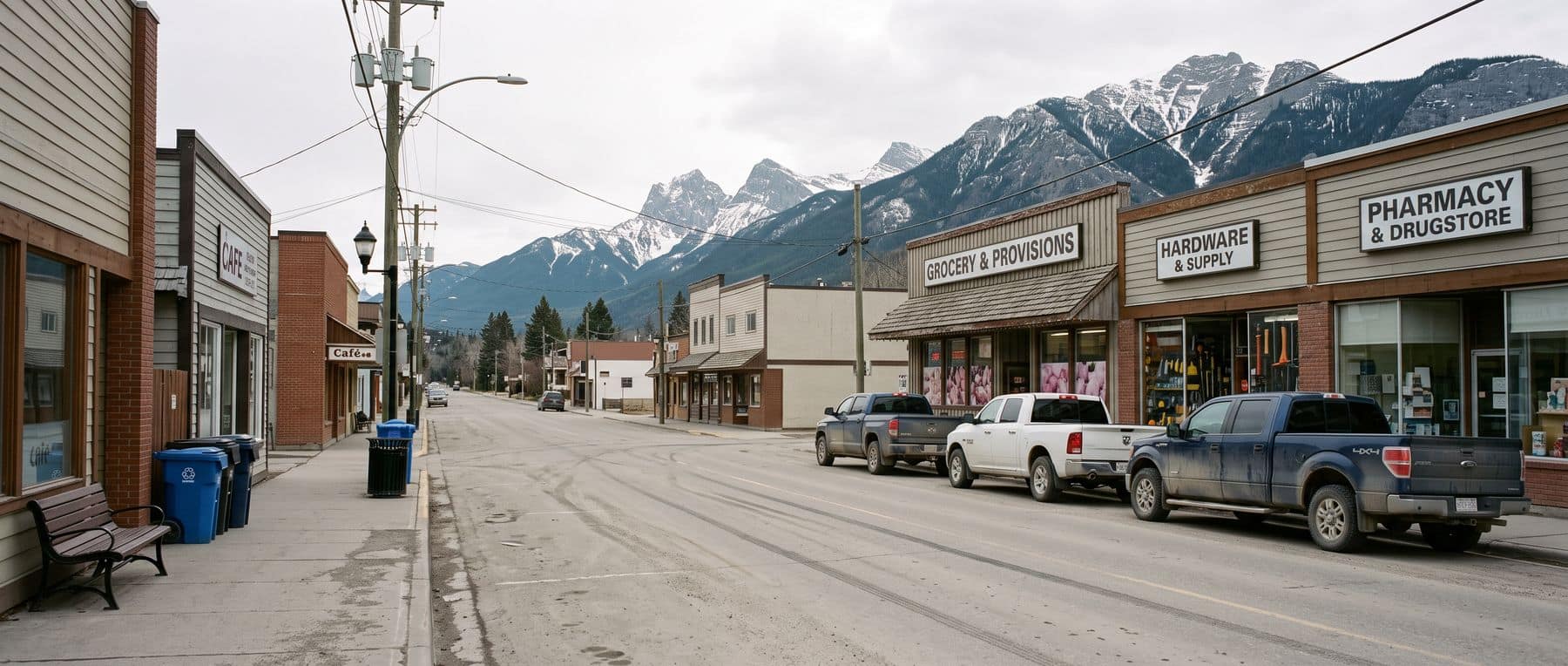
- Housing is 50–60% of a typical Canmore budget. Rent for a two-bedroom averaged $2,446 (2025); a $1.08M median purchase with 20% down carries roughly $5,000 a month in mortgage before tax and fees.
- Non-housing costs are close to the rest of Alberta: about 3% higher, with no provincial sales tax and free local transit.
- The living wage was $38.80 an hour (2023, the last year Canmore participated), per the Alberta Living Wage Network, versus $23.70 in Calgary. The difference is almost entirely rent.
- Owners add property tax (about $5,500 a year on a $1.2M home at the 2026 primary-residential rate of 0.457%), condo fees where applicable, and utilities that spike in winter.
- A single renter needs roughly $75,000–90,000 gross to live comfortably; a family buying at the median needs $200,000-plus household income under normal lending.
The cost of living Canmore households actually carry comes down to one line on the budget. Groceries, fuel, utilities and a night out cost about what they do in Calgary or Cochrane, a few percent more, offset by free local buses and no provincial sales tax. Housing does not. Rents are among the highest in Alberta, the median home sale is above a million dollars, and the result is a 2023 living wage of $38.80 an hour (2023, the last year Canmore participated), the highest the Alberta Living Wage Network calculates. This guide builds a monthly budget line by line, for a renter and for an owner, with every figure dated and sourced.
- Average two-bedroom rent
- $2,446 / mo
- 2025 · Alberta Regional Dashboard · +7.8% YoY
- Average one-bedroom rent
- $1,880 / mo
- 2025 · Alberta Regional Dashboard · +13% YoY
- Median home sale
- $1,084,950
- July 2026 · Wahi
- Basic utilities, 85 m²
- ≈ $389 / mo
- June 2026 · Numbeo (13 contributors)
- Living wage
- $38.80 / hr
- Alberta Living Wage Network · Calgary $23.70
- Local bus fare
- Free
- Roam routes 5C, 5T, 12 · 2026
Housing: the biggest cost of living in Canmore
Renting. The average two-bedroom in a purpose-built rental building was $2,446 a month in 2025, up 7.8% in a year; a one-bedroom averaged $1,880, up 13% (Alberta Regional Dashboard, from the Alberta open data set). Those are averages across sitting tenants. What you will actually be quoted is closer to Numbeo’s June 2026 user reports: $2,150 for a one-bedroom in the centre, $2,275 outside it, and $4,700–5,000 for a three-bedroom. Vacancy is close to zero, and much of the rental stock is basement suites and condos owned by individuals rather than apartment buildings.
Buying. The median sale across all property types was $1,084,950 in July 2026 (Wahi). Apartment condos averaged about $814,000 and townhouses $1.15M in 2025. The market overview has the full breakdown; the point here is what it does to a monthly budget. At the median price with 20% down and a five-year fixed rate near 4.5%, the mortgage is roughly $4,800 a month before property tax, utilities and any condo fees. That 4.5% is a working assumption in the middle of an August 2026 range that runs from discounted insured rates below 4% to big-bank conventional rates near 5%; get an actual quote from a licensed mortgage broker before you rely on the payment.
Owning costs beyond the mortgage. The Town’s Rate of Taxation Bylaw 2026 sets the all-in primary-residential rate at 0.00456554, or 0.457%, and that total already includes the municipal rate, the provincial education requisition, the seniors requisition and the Vital Homes affordable-housing levy: it is not an extra line on top. So an Alberta-resident owner of a $1.2M home pays about $5,500 a year. A non-primary residence sits in a different class at 0.00833462, or 0.833%, roughly $10,000 on the same home, because the Livability Tax lifts the municipal portion by 0.377% of assessed value. Condo fees vary enormously by building, from a few hundred dollars a month for a simple townhome complex to well over $1,000 for a hotel-style building with a pool, and the only figure worth budgeting is the one on the specific unit’s estoppel certificate. The property tax guide explains the rate.
Utilities, internet and the Town bill
Numbeo’s June 2026 estimate for basic utilities: electricity, heating, water and garbage, on an 85 m² home is about $389 a month, with broadband around $98. Treat the utilities figure as an annual average: natural-gas heating in a detached Canmore home runs several times higher in January than in July, and older homes with big windows and cathedral ceilings are the worst offenders. The Town bills water, wastewater, recycling and solid waste separately, with fixed base charges plus metered consumption. For a single-family home on a 15 mm meter the 2026 bi-monthly base charges are $75.54 water, $113.32 wastewater, $49.20 solid waste and $36.42 recycling, $274.48 in total, or about $137 a month before a drop of water is used. Consumption adds $1.724 per cubic metre for water and $2.586 for wastewater, rising to $2.069 and $3.103 above 47 m³ in a billing cycle. The Town raised the water and wastewater rates for 2026 to fund wastewater treatment plant work and the Railway Avenue deep-utility upgrade. The Canmore winter guide covers heating in more detail.
Groceries, dining and everyday costs
Day-to-day costs are where Canmore looks like the rest of Alberta. Numbeo’s June 2026 figures: milk $3.09 a litre, a loaf of bread $3.48, a dozen eggs $4.83, chicken $17.50 a kilo, an inexpensive restaurant meal $25 and petrol $1.46 a litre. Two supermarkets, a Costco run to Calgary for bulk shopping and a solid farmers’ market in summer are how most households manage it. Restaurants and cafés are priced for visitors, expect Calgary-plus on Main Street, but there is no provincial sales tax, which offsets a good deal of the difference against Ontario or B.C.
Transport
Local Roam Transit routes 5C Cougar Creek, 5T Three Sisters and Route 12 are free to ride, with seasonal service to Quarry Lake and the Nordic Centre from May to October. The regional bus to Banff is $6 one way or $80 for a 31-day pass (Roam, 2026). Most households still run a car, and winter tires are a practical necessity from October to April. The cost that surprises people is the Calgary commute: about 210 km round trip, which at $1.46 a litre and 8 L/100 km is roughly $25 in fuel per day before wear and parking, around $250 a month at two days a week.
Childcare, healthcare and the rest
Childcare in Canmore is scarce and waitlisted. Under the federal-provincial agreement Alberta moved to a flat $15-a-day parent fee on 1 April 2025, which works out to $326.25 a month for full-time care and $230 for part-time at a licensed daycare or day home that takes the affordability grant, and the province has said it intends to reach $10 a day (alberta.ca). The fee is the easy part. Alberta names Canmore and Banff as high-waitlist communities, waits run months, and many families rely on day homes in the meantime; the Town does not publish a live space count, so phone providers directly. Healthcare is publicly insured through Alberta Health Care once you register (apply within three months of arriving), with dental, vision and prescriptions out of pocket or through an employer plan. Ski passes, bikes, avalanche courses and gear are the discretionary line that Canmore households consistently underestimate; a family’s winter can run $3,000–6,000 in passes and equipment before a single hotel night.
A worked monthly budget
| Line | Single renter, one-bedroom | Family of four, owning at the median |
|---|---|---|
| Rent or mortgage | $1,900–2,275 (Alberta dashboard; Numbeo) | ≈ $4,800 mortgage (20% down, ≈ 4.5%) |
| Property tax | n/a | ≈ $460 (Alberta resident, 0.457% on $1.2M) |
| Condo fees or maintenance | n/a | $300–600 |
| Utilities and internet | $250–350 (share of $389 + $98) | $500–600 |
| Groceries | $500–600 | $1,400–1,700 |
| Transport (car, fuel, insurance) | $300–500 | $700–1,000 |
| Childcare | n/a | $0–650 (two licensed full-time spaces at $326.25 each, alberta.ca) |
| Phone, insurance, subscriptions | $150–250 | $350–450 |
| Recreation, dining, gear | $400–700 | $800–1,200 |
| Total | ≈ $3,900–4,700 | ≈ $9,400–12,300 |
The renter total implies roughly $75,000–90,000 gross income for a comfortable life; the owner total implies a household income above $200,000, which is why so many full-time Canmore households have one Calgary-level salary and one local job, or arrived with equity. Ranges are our estimates from the sourced inputs above; your numbers will differ.
Buyers price the mortgage and stop. In Canmore the second layer: property tax, condo fees, winter gas, the Calgary drive, ski passes, routinely adds $1,500–2,500 a month to a family budget. Run the buyer cost calculator with the condo fees and tax class of the actual property, not a placeholder.
How Canmore compares
Against Calgary, housing is the whole story: Calgary’s total residential benchmark was $569,200 in July 2026 and its detached benchmark $743,900 (CREB), roughly half Canmore’s equivalents, while everything else is within a few percent. Cochrane, 40 minutes closer to Calgary, had a detached benchmark of $659,400 the same month; the Cochrane comparison page works through that trade. Against B.C. Mountain towns, Canmore wins on no provincial sales tax, no land transfer tax and no speculation tax for Albertans, and loses on the Livability Tax if you live out of province.
A local REALTOR®’s observation after years of watching new arrivals: the households that make Canmore work buy the smaller, sunnier place walkable to school and the rec centre, run one car instead of two, and use the free bus and the pathway network for the daily stuff. The ones who struggle bought the big house on the shady side and drive everywhere, including to Calgary four days a week.
What this means if you’re buying
Budget for the second layer before you fall for a listing, take the purchase price you are considering, add property tax at the class that applies to you, the building’s actual condo fees, a winter utilities figure rather than an annual average, and the commute if you have one, and see whether the monthly total still fits. The buyer cost calculator does that arithmetic, and the Canmore vs Calgary tool shows what the same money buys down the highway. If the total works, Canmore’s day-to-day costs will not surprise you; if it does not, no amount of trail access fixes it.
Everything else about day-to-day life here, from winter to work, is in day-to-day life in Canmore. Set the housing line honestly and the rest of the cost of living Canmore asks of a household looks a lot like the rest of Alberta.
A local REALTOR® pulls the building’s condo fees, tax class and typical utilities and puts them beside the price. Fifteen minutes, free, no obligation.
Budgeting for the move itself is a separate job: moving to Canmore covers the 90-day licence and registration rules and what to sort in what order.
Frequently asked
How much does it cost to live in Canmore per month?
For a single renter in a one-bedroom, roughly $3,900–4,300 a month all in at 2025–26 prices: rent about $1,900–2,275, utilities and internet about $350, groceries $500–600, transport $200–400, and $700–900 for everything else. A family of four owning a median-priced home is closer to $9,000–11,000 a month once the mortgage, property tax, utilities and childcare are counted.
What is the living wage in Canmore?
$38.80 an hour (2023, the last year Canmore participated), according to the Alberta Living Wage Network, the highest of any Alberta community it calculates, compared with $23.70 in Calgary and $20.85 in Edmonton. The living wage is what each of two working parents with two children needs to cover a basic budget without public assistance; housing costs explain nearly all of Canmore’s premium.
How much is rent in Canmore?
The average two-bedroom in a purpose-built rental building was $2,446 a month in 2025, up 7.8% from $2,269 in 2024, and a one-bedroom was $1,880, up 13% (Alberta Regional Dashboard). User-reported asking rents on Numbeo in June 2026 were higher: $2,150–2,275 for a one-bedroom and $4,700–5,000 for a three-bedroom, which reflects the open market rather than sitting tenants.
Is Canmore more expensive than Calgary?
For housing, dramatically: Canmore’s median sale of $1,084,950 in July 2026 was nearly double Calgary’s total benchmark of $569,200 (CREB), and rents run 30–50% higher. For groceries, fuel, utilities and dining, the two are within a few percent of each other. The Canmore vs Calgary tool shows what the same budget buys in each.
Are utilities expensive in Canmore?
Moderately. Numbeo’s June 2026 estimate for basic utilities (electricity, heating, water, garbage) on an 85 m² home is about $389 a month, with internet about $98. Winter natural-gas bills are the variable, and no one publishes a Canmore seasonal range, so ask a seller for twelve months of bills. Town water, sewer and waste arrive on a separate municipal bill: for a single-family home the 2026 base charges total $274.48 every two months, about $137, before metered consumption.
How much do I need to earn to buy a home in Canmore?
At the July 2026 median of about $1.08M with 20% down and a five-year fixed rate around 4.5%, the mortgage alone is roughly $4,800 a month. With property tax, heat and any condo fees, that points to household income above $200,000 under normal lending ratios, and a condo at $700–800K to roughly $140,000–160,000. These are illustrations, not an approval: qualifying depends on the stress test, your debts and the lender, so run the numbers with a licensed mortgage broker.
- Alberta Regional Dashboard: Canmore average residential rent
- Numbeo: Cost of living in Canmore (June 2026)
- Alberta Living Wage Network: Reports
- Wahi: Canmore housing market report (July 2026 data)
- CREB: July 2026 statistics
- Roam Transit: Fares
- Rocky Mountain Outlook: Town of Canmore passes 2026 tax rate
- Town of Canmore: Utilities
- Town of Canmore: 2026 residential utility rates
- Town of Canmore: 2026 tax rates
- Alberta: Childcare fees
Keep reading

Tell us what you’re looking for and get a straight answer, usually the same day.