Dead Man’s Flats Real Estate
Dead Man's Flats real estate: the Bow Valley's most affordable Canmore-adjacent condos, its visitor-accommodation buildings, the 75-day rule, and what investors should check.
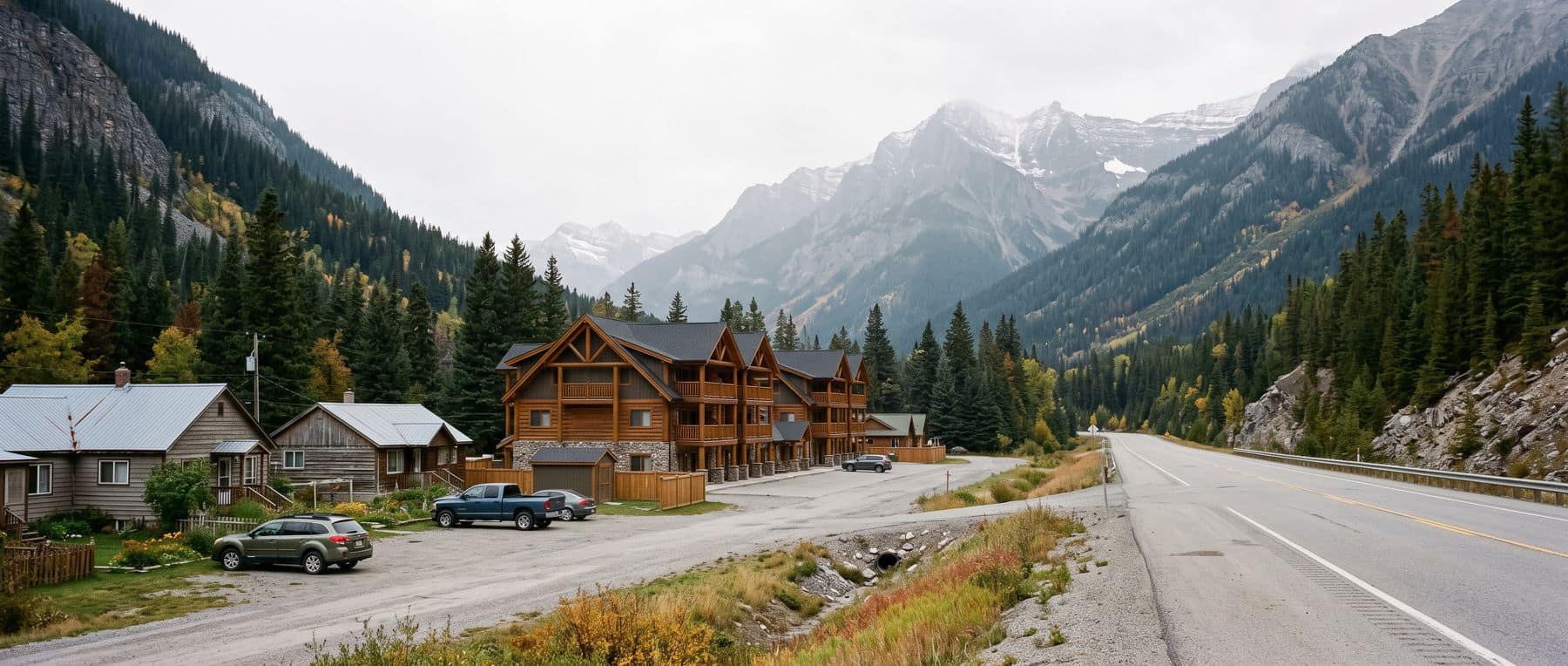
- The corridor's lowest-priced condo entry point, roughly ten minutes east of Canmore with municipal water and sewer.
- Visitor-accommodation buildings (Copperstone Resort; the approved Sparrowhawk Lodge and Cliff Resort projects) serve nightly guests, but a 75-day-per-person annual occupancy cap applies.
- Visitor-accommodation units are taxed in the commercial bracket by the MD of Bighorn.
- Canmore's Livability Tax and tourist-home tax class do not apply in Dead Man's Flats.
- Residential Dead Man's Flats, the 1992 condos and River's Bend, is a separate, ordinary housing market.
Dead Man's Flats real estate is where the Bow Valley's price floor and its short-stay economy meet. Ten minutes east of Canmore, this MD of Bighorn hamlet offers the corridor's cheapest condo entry point, a small residential subdivision, and, unusually for a community of its size, a cluster of visitor-accommodation buildings that function like condo hotels. It is also where investors most often mix up two very different products: the visitor-accommodation unit and the Canmore tourist home. This page keeps them straight.
Location and character of Dead Man's Flats real estate
The hamlet sits at the mouth of Wind Valley where Pigeon Creek meets the Bow River, wrapped around a highway interchange with Pigeon Mountain behind it. The MD notes it "was developed primarily as a commercial centre": gas, food and lodging for the highway, with housing arriving in layers: a 44-unit condominium development in 1992, then the 2013 Area Structure Plan and the River's Bend subdivision, "a 78 unit residential and light industrial subdivision." An asphalt trail runs along the boundary of the Pigeon Creek condominiums, there is a CSA-standard playground in River's Bend and a community-maintained winter rink.
The name, for the record, is original: officially adopted in 1985 (replacing "Pigeon Mountain Service Centre"), it recalls the 1904 axe murder of dairy farmer Jean Marret by his brother François, who was found not guilty by reason of insanity, and a Stoney Nakoda account associated with the same flats. A 2014 request to rename the hamlet went nowhere. Listings and search engines carry it both ways, Dead Mans Flats and Dead Man's Flats, so set alerts for both spellings. A search for Dead Mans Flats Alberta and a search for the apostrophe form return the same small pool of listings, and MLS feeds are inconsistent about which they use.
The residential side: condos and River's Bend
Ordinary residential Dead Man's Flats real estate means the older condo stock and River's Bend's newer homes. The postal address is Dead Man's Flats, Alberta, and the hamlet answers to the MD of Bighorn rather than the Town of Canmore. Qualitatively, this is the most affordable Canmore-adjacent address in the valley, the reason first-time Bow Valley buyers and Canmore workers keep it on their lists, with municipal water and wastewater service, which its hamlet peers to the west and east cannot all claim. Inventory is small and lumpy; single listings, not streams.
Jurisdiction matters here as everywhere in the MD: no Canmore Livability Tax, no primary-residence declaration, no Canmore tourist-home class. A weekend condo at Dead Man's Flats carries none of the vacancy-tax overhead an identical Canmore condo would for an out-of-province owner.
The visitor-accommodation stock: how it actually works
This is the part investors come for, and the part with the sharpest rules. Three names define it:
- Copperstone Resort: the established condo-hotel style property, rezoned from resort accommodation to visitor accommodation in 2022, with guest-registry conditions to enforce compliance. The the Copperstone resort building page has the assessment split and what a unit costs to hold.
- Sparrowhawk Lodge: a 107-unit visitor-accommodation building with two retail spaces, approved by the MD's Municipal Planning Commission in March 2022; individually owned units rented to guests, with a fitness room, pool and hot tub, and 150 parking stalls.
- Cliff Resort: a mixed-use project at 150 1st Avenue approved in August 2023: 25 visitor-accommodation units, retail and a restaurant, plus up to 65 "flexible accommodation" units intended for short- and Canmore long-term rental.
Side by side, the three visitor-accommodation projects in Dead Mans Flats look like this:
| Building | Status | Visitor-accommodation units | Also includes |
|---|---|---|---|
| Copperstone Resort | Established; rezoned from resort accommodation to visitor accommodation in 2022 | Existing condo-hotel style units | Guest-registry conditions to enforce compliance |
| Sparrowhawk Lodge | Approved by the MD's Municipal Planning Commission, March 2022 | 107 | Two retail spaces, fitness room, pool and hot tub, 150 parking stalls |
| Cliff Resort (150 1st Avenue) | Approved August 2023 | 25 | Retail, a restaurant, and up to 65 flexible-accommodation units for short- and long-term rental |
The rule that shapes everything, as reported by the Rocky Mountain Outlook from the MD's planning documents: "a person would be unable to stay in the building for more than 75 days per year" in visitor accommodation, and "taxes collected on the build would be in the commercial bracket."
A Canmore tourist home can be your home, your tenant's home, or a nightly rental, owner's choice. A Dead Man's Flats visitor-accommodation unit cannot: no person may occupy it beyond 75 days a year, guest registries can be audited, and the taxation is commercial. If your plan involves living in the unit for a season, this is the wrong product, look at Canmore tourist homes or at the Cliff Resort's flexible-accommodation category instead, and verify that category's current rules with the MD before relying on it.
Running the investment numbers
Treat a visitor-accommodation unit as a pure revenue property: nightly rate and occupancy against condo fees, management, commercial-class taxes and financing that lenders will price as an income property (Canmore STR buyers typically see 25–35% down payment expectations, and hamlet condo-hotel product lands in similar territory, confirm with your broker). Bow Valley short-term rental benchmarks are Canmore-centric, ADR roughly $302–334 and occupancy roughly 58–80% across data vendors for 2025–26, and Dead Man's Flats properties trade on the same visitor demand at a lower buy-in, generally with lower achievable rates. No public data source breaks revenue out building by building for this hamlet, so ask the operator or the condominium corporation for the actual last-two-years occupancy and average daily rate on the specific building before you model anything.
- Canmore-area ADR
- $302–334
- 2025–26 range across STR data vendors: use as a ceiling benchmark
- Canmore-area occupancy
- 58–80%
- range by vendor and period, 2025–26
- Personal use cap
- 75 days/yr
- visitor accommodation, MD of Bighorn rules (RMO, 2022–23)
The tourist home ROI calculator works for any nightly-rental unit, plug in conservative Dead Man's Flats rates and the commercial tax load, and see whether the spread over a Canmore tourist home's price premium still favours the hamlet. The visitor accommodation explainer covers the three categories in depth.
Growth, friction and the wildlife corridor
Dead Man's Flats is the MD's designated growth node, and that has produced friction: when the MD rezoned land near the wildlife underpass toward light industrial, the Town of Canmore appealed, arguing the area functions as a wildlife corridor (CBC, 2015). Buyers should expect continued build-out under the 2013 area redevelopment plan, more visitor accommodation, more retail at the interchange, and should read current development applications before buying next to a vacant parcel.
Who it suits, and who it doesn't
The hamlet suits the entry-level Bow Valley buyer who wants Canmore at arm's length, and the investor who wants nightly-rental exposure below Canmore's tourist-home premium and can live with the 75-day cap. It does not suit buyers wanting walkable services, a quiet non-highway setting, or a property that flexes between personal use and rental. Against its neighbours: Harvie Heights real estate offers big residential lots closer to Canmore at higher prices; Lac des Arcs real estate, five minutes further east, trades amenities for lake views and detached homes on septic.
In visitor-accommodation buildings, the condo documents matter more than the view. Read the management agreement, the rental-pool terms if any, the fee history and the registry-audit conditions before falling for a pro forma. Two units in the same building can produce very different net income depending on how they are run.
What this means if you're buying
Dead Man's Flats real estate comes in two forms, so decide which you are buying: the residential hamlet (ordinary financing, ordinary taxes, no vacancy tax) or the visitor-accommodation economy (commercial taxes, 75-day cap, revenue-property underwriting). Get the land-use district and permitted uses in writing from the MD, stress-test revenue at hamlet rates rather than Canmore rates, and compare the all-in numbers against a Canmore tourist home for sale before committing. The cheaper door is not always the better yield.
For how Dead Man's Flats real estate compares with the others in the valley, see the areas near Canmore overview.
A local REALTOR® can pull building-level history for Copperstone and the residential stock, and walk you through the ROI calculator with real assumptions. Free 15-minute call.
If a cabin is what you are after, Canmore cabins for sale covers the Bow Valley hamlets and what each one allows.
Frequently asked
Where is Dead Man's Flats and why is it called that?
It sits on the Trans-Canada about ten minutes east of Canmore, in the MD of Bighorn. The hamlet was officially named Dead Man's Flats in 1985, before that it was Pigeon Mountain Service Centre, reviving a local name tied to the 1904 killing of dairy farmer Jean Marret by his brother, one of the Bow Valley's few truly local place names.
Can I buy an Airbnb-style property in Dead Man's Flats?
Yes, in the visitor-accommodation buildings, units there are owned individually and rented to guests, with hotel-style amenities. But under the MD's land use bylaw a person cannot stay in a visitor-accommodation building more than 75 days per year, so it cannot double as your part-time residence, and the units are taxed commercially. Model it as a revenue property, underwritten the way you would any Canmore investment property, not a hybrid.
How is a Dead Man's Flats visitor-accommodation unit different from a Canmore tourist home?
A Canmore tourist home is residentially usable. You or a tenant can live in it year-round, while also being legal for nightly rental, and it is taxed at Canmore's non-residential rate. A Dead Man's Flats visitor-accommodation unit carries a 75-day annual occupancy cap per person and commercial taxation under a different municipality's bylaw. Similar revenue idea, materially different rules.
Does Canmore's vacancy tax apply to Dead Man's Flats condos?
No. Dead Man's Flats is governed by the MD of Bighorn, which has no Livability Tax and no primary-residence declaration. A second-home owner there pays standard MD property taxes, though visitor-accommodation units are assessed in the commercial bracket regardless. That gap is the practical draw for out-of-province owners, because an identical condo inside the Town boundary would carry the vacancy-tax overhead. Confirm your unit's land-use district with the MD before you rely on it.
Is Dead Man's Flats a good place to live full-time?
For the right buyer, yes: municipal water and sewer, a playground and community rink, an asphalt trail, and Canmore ten minutes away at a lower buy-in. The trade-offs are highway proximity, few services in the hamlet itself, and construction activity as approved projects build out. Families use the Canmore schools or Exshaw School.
- MD of Bighorn: Dead Man's Flats
- Rocky Mountain Outlook: Visitor accommodation approved for Dead Man's Flats (Sparrowhawk Lodge)
- Rocky Mountain Outlook: Mixed-use Cliff Resort approved by MD for Dead Man's Flats
- Rocky Mountain Outlook: Dead Man's name change request denied
- CBC: Dead Man's Flats plan pits Canmore against MD of Bighorn
- MD of Bighorn: Water & Wastewater
Keep reading

Tell us what you’re looking for and get a straight answer, usually the same day. Free, and no obligation.
Nightly rate, occupancy, management fees, tourist-home tax and financing, cash flow, cap rate and break-even in one place.
Tourist-home ROI calculator