Harvie Heights Real Estate
Harvie Heights real estate: big lots and mountain views five minutes west of Canmore, at the Banff park gate, with MD of Bighorn rules, wells and septic to understand.
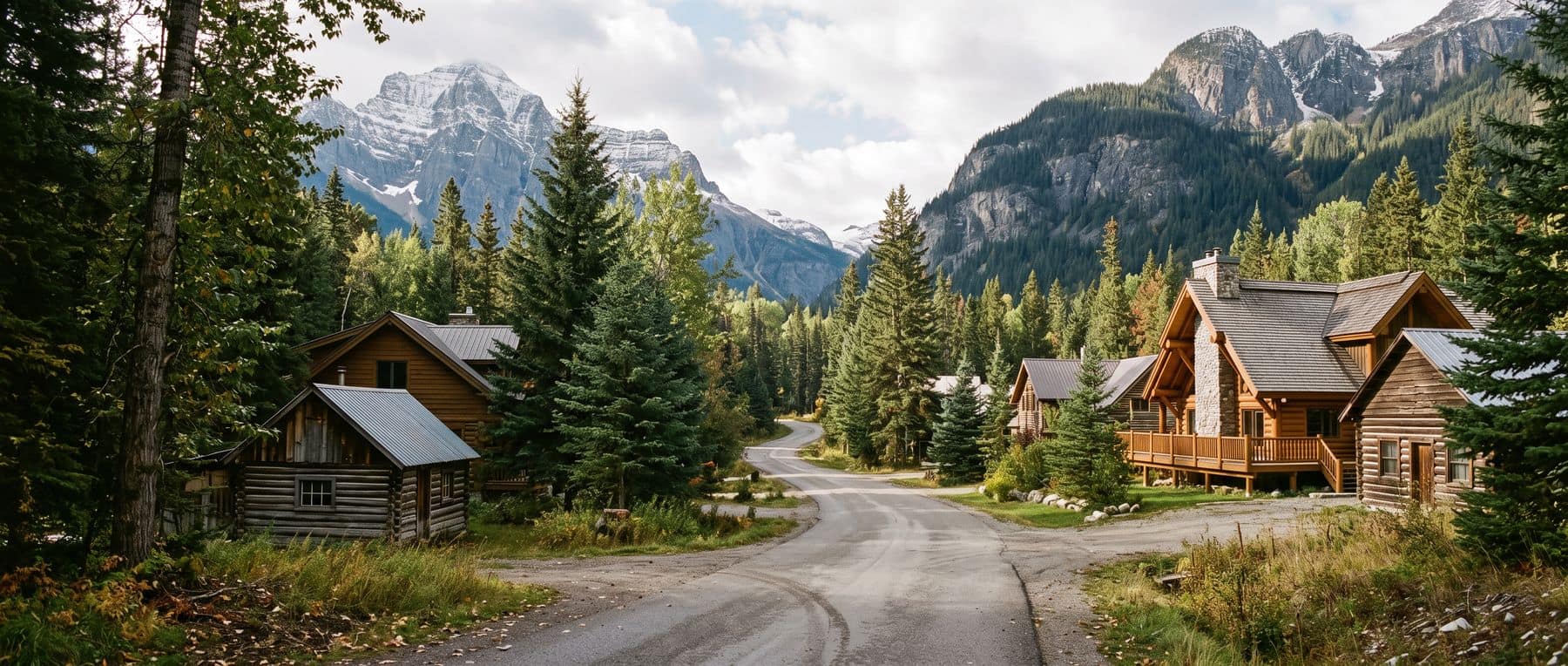
- Five minutes from Canmore and effectively at the Banff park gate, without Banff's need-to-reside rule or leasehold land.
- Origins as a seasonal cottage community mean varied housing stock: original cabins beside substantial rebuilt homes on large lots.
- In 2021, only 81 of 152 private dwellings were occupied by usual residents, weekend homes have always been part of the fabric.
- Municipal water and sewer serve only the highway commercial strip; residential lots generally run on wells and septic.
- Governed by the MD of Bighorn Land Use Bylaw. No Canmore Livability Tax, no Canmore tourist-home regime.
Harvie Heights real estate is the shortest possible answer to a common Bow Valley problem: you want to be next to Banff National Park, you cannot (or will not) deal with Banff's ownership rules, and Canmore's detached prices sting. The hamlet sits about five minutes west of Canmore on the valley's north side, directly at the park's east gate, close enough that its asphalt trail "connects to the east with the Town of Canmore" and continues westward through Banff National Park, as the MD of Bighorn puts it. Here is what buying there actually involves.
Location and character of Harvie Heights real estate
Harvie Heights is a compact pocket of streets above the Trans-Canada, facing across the valley toward the Three Sisters and Mount Rundle's long ridge. The MD describes its origins plainly: it was "originally developed in the late 1950s and early 1960s as a seasonal cottages community with a highway commercial component," and it has been evolving toward permanent residency ever since. That history is visible on the ground: original cabins sit beside large rebuilt homes, and a strip of motels and visitor businesses lines the highway frontage, organised under their own business association.
It is quiet in a way Canmore no longer is. Community life runs through the Harvie Heights Community Association and a hall that is itself a relocated historic Banff cabin; there is an outdoor rink, a tennis court and a playground rebuilt in 2018. There are no shops in the residential area. Every errand is a five-minute drive into Canmore.
Who owns homes here, and who is here most of the year
The 2021 Census counted 163 residents and 152 private dwellings, of which only 81 were occupied by usual residents: nearly half the homes, in other words, are weekend places, seasonal cabins or otherwise not primary residences. That is the highest non-primary share of any hamlet in the corridor. That mix persists: long-time locals, Canmore workers who wanted a bigger lot, and out-of-town owners who treat Harvie Heights as their mountain base.
Set against the other MD of Bighorn hamlets in the corridor, the pattern is clear. These are the 2021 Census counts for each designated place:
| Hamlet | Population | Private dwellings | Occupied by usual residents | Share occupied |
|---|---|---|---|---|
| Harvie Heights | 163 | 152 | 81 | 53% |
| Dead Man’s Flats | 377 | 162 | 128 | 79% |
| Exshaw | 449 | 185 | 170 | 92% |
| Lac des Arcs | 146 | 82 | 57 | 70% |
Exshaw is a working village where nine in ten homes are lived in year-round. Harvie Heights real estate sits at the other end of that range, which shapes how the hamlet feels midweek in November and how quickly a well-positioned listing draws interest from outside the valley.
Because the hamlet is MD of Bighorn territory, that second-home pattern carries no tax penalty. There is no Livability Tax, no December 31 declaration, no vacancy-tax paperwork at all. For an out-of-province buyer comparing a Canmore weekend home against a Harvie Heights one, that difference is worth roughly 0.377% of assessed value every year at Canmore's 2026 rate.
Harvie Heights real estate: property types and what they sell for
The stock is almost entirely detached homes and cabins on generous lots, the acreage-feel parcels that Canmore's grid rarely offers, plus the commercial motel strip. Listings are scarce; a year can pass with only a handful of sales, so pricing is qualitative: expect a wide band, from dated original cabins priced as land value up to substantial view homes that compete with Canmore's upper detached market. If a cabin is specifically what you want, the Canmore cabins for sale guide tracks this corridor.
- Population
- 163
- 2021 Census, Statistics Canada designated place
- Dwellings occupied by usual residents
- 81 of 152
- 2021 Census: 53%, a strong weekend-home share
- Drive to Canmore
- ≈ 5 min
- Trans-Canada Highway, off-peak
Sun, winter and services
The hamlet sits on the valley's north side, the aspect that catches the better winter sun in this stretch of the Bow Valley, though sun on a given lot depends on trees, slope and the ridge behind it far more than on the hamlet's overall aspect: visit in the middle of a winter day before you decide. Winters bring the same snow-and-chinook rhythm as Canmore, with one practical difference: services are rural. Municipal water and wastewater exist "within the highway commercial district of Harvie Heights" only (MD of Bighorn); residential lots run on private wells and septic fields, garbage goes to central hamlet bins, and fire response comes from volunteer departments under mutual aid with Canmore and Banff.
No utility bills from a town, but also no town behind the taps. Regulation of private sewage systems is provincial, and maintenance is entirely the owner's responsibility. Make any offer conditional on a water quantity and quality test and a septic inspection, and budget for periodic pump-outs. Buyers coming from city services skip this at their peril.
Short-term rental status
Residential Harvie Heights is not a nightly-rental district. The MD of Bighorn regulates bed and breakfasts and suites through its Land Use Bylaw, 2024 reporting in the Rocky Mountain Outlook noted the bylaw capped visitor accommodation at 30 per cent of a single-detached home, with council reviewing suite and B&B rules and emphasizing permanent residency as a cornerstone. A new Land Use Bylaw (10-26) was adopted on July 13, 2026; confirm current permitted uses and any permit requirements with the MD before underwriting rental income. The commercial strip's motels are a separate, commercial land-use world.
Who it suits, and who it doesn't
Harvie Heights suits buyers who want maximum mountains per dollar of commute: Canmore workers wanting land and quiet, park-adjacent weekenders, and the Banff-blocked buyer who discovers the need-to-reside rule and wants the closest freehold alternative to the park gate. It does not suit anyone who wants to walk to coffee, needs municipal services, or is counting on short-term rental revenue.
Against its neighbours: Dead Man's Flats offers condos, municipal utilities and the corridor's visitor-accommodation stock at lower entry prices, while Exshaw real estate trades another ten minutes of driving for the valley's most affordable detached homes and a K–8 school. Harvie Heights beats both on proximity to Canmore and the park, and usually costs accordingly.
Harvie Heights listings often move on view and lot quality more than on the house itself. Buyers here are frequently planning a renovation or eventual rebuild. Walk the lot in the afternoon to judge sun, listen for the highway from the deck, and ask early about well output and septic age. Those four checks decide most Harvie Heights real estate purchases.
What this means if you're buying
Harvie Heights real estate rewards preparation: set up alerts and be ready to move, because inventory is thin and the good lots go quickly. Line up a well-and-septic inspector at the same time as your home inspector, confirm land-use rules with the MD if suites or B&B income are part of the plan, and price the absence of the Livability Tax into any Canmore-versus-hamlet comparison if you live outside Alberta. Then decide with your feet: five minutes from Canmore, one gate from the park, and quiet enough to hear the highway only when the wind turns.
Each of the communities around Canmore is compared on price, rules and commute in the areas guide, which is the quickest way to weigh Harvie Heights real estate against the alternatives before you commit.
A local REALTOR® watches Harvie Heights real estate daily and can set up instant alerts for the hamlet and the corridor around it. Fifteen minutes, free, no obligation.
Frequently asked
Where is Harvie Heights?
On the north side of the Trans-Canada Highway immediately west of Canmore, in the Municipal District of Bighorn. It is the last hamlet before the Banff National Park east gate, roughly a five-minute drive from Canmore's shops and about twenty-five minutes from the Town of Banff.
Is Harvie Heights part of Canmore?
No. Harvie Heights is a hamlet of the MD of Bighorn, with its own council, property taxes and Land Use Bylaw. Canmore-specific programs. The Livability Tax, the primary-residence declaration and the tourist-home tax class, do not apply to Harvie Heights properties.
Can I use a Harvie Heights house as a weekend home without extra tax?
Currently yes. The MD of Bighorn has no vacancy tax and requires no primary-residence declaration, so a second home here pays standard MD property tax regardless of where you live. That is a meaningful difference from buying in Canmore from out of town for out-of-province buyers, who would face roughly 0.377% of assessed value per year there.
Can I run a short-term rental in Harvie Heights?
Not as a matter of course. The MD regulates bed and breakfasts and suites through its Land Use Bylaw, 2024 reporting noted a cap of 30 per cent of a single-detached home for visitor accommodation, alongside residency and permitting requirements. The bylaw was replaced in July 2026, so confirm current rules with the MD's planning department before buying on rental income.
What are the utilities like in Harvie Heights?
The MD provides municipal water and wastewater only within the highway commercial district; residential properties generally rely on private wells and septic systems, which are the owner's responsibility. Budget for water testing and a septic inspection during due diligence, and for periodic pump-outs afterward.
- MD of Bighorn: Harvie Heights
- MD of Bighorn: Water & Wastewater
- MD of Bighorn: Census Data
- Statistics Canada: 2021 Census Profile, designated places in the MD of Bighorn (Exshaw, Harvie Heights, Lac des Arcs, Dead Man’s Flats)
- MD of Bighorn: Land Use Bylaw
- Rocky Mountain Outlook: MD of Bighorn examining bed and breakfast, suite regulations
Keep reading

Tell us what you’re looking for and get a straight answer, usually the same day. Free, and no obligation.