Canmore Tourist Home vs Residential vs Visitor Accommodation
Canmore tourist home vs residential vs visitor accommodation: the three designations that decide nightly rental, full-time living, tax and financing.
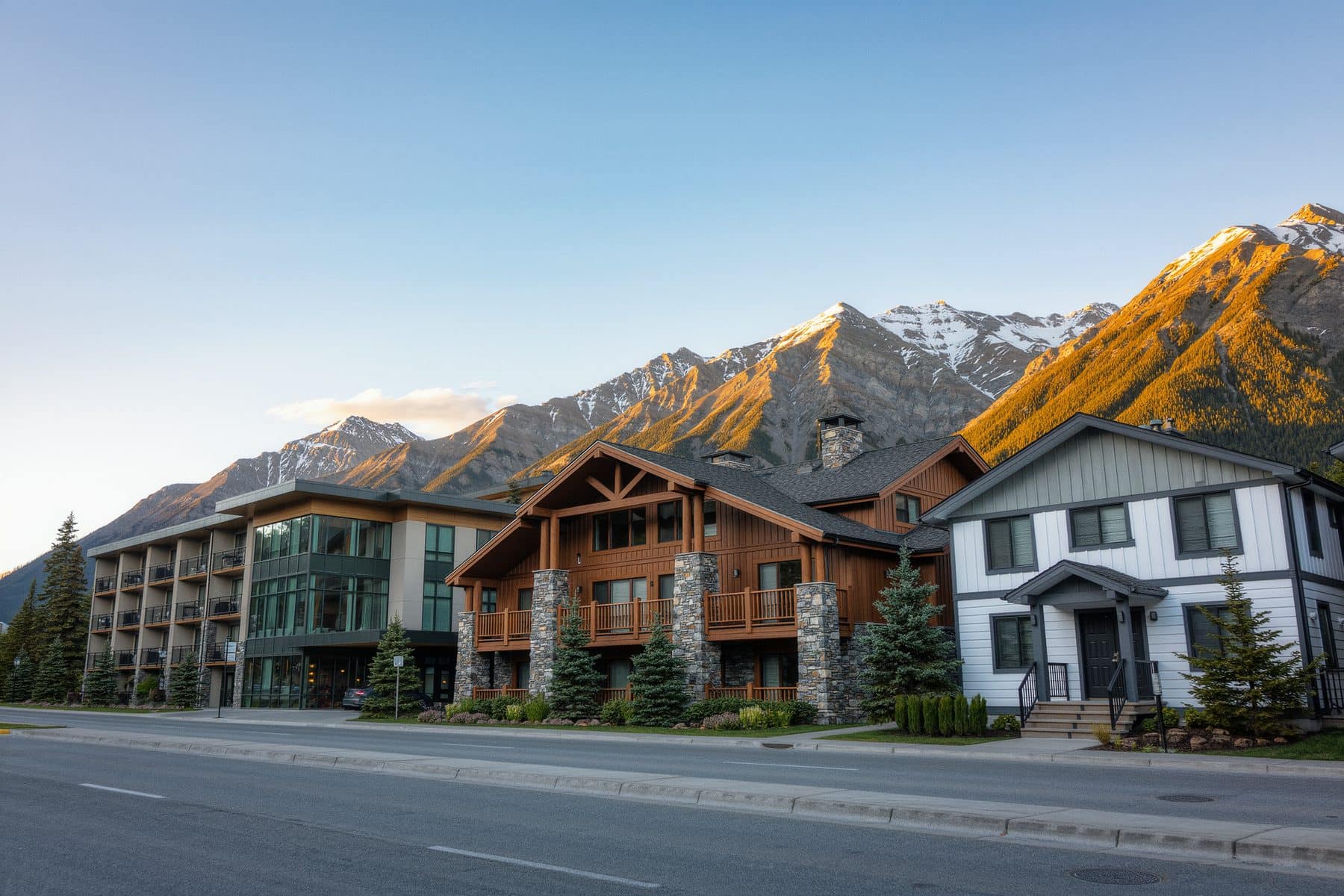
- Tourist Home is the only designation that permits both nightly rental and full-time residency.
- Visitor Accommodation cannot be lived in, occupancy is capped at 30 days and many titles carry a 28-day restriction.
- Residential may not be advertised on short-term listing sites at all, apart from a licensed three-room bed and breakfast.
- In 2026 the total tax rates are 0.457% (primary residence), 0.832% (tourist home) and 0.957% (non-residential).
- Mixed buildings are common in Canmore. The Town has counted nine visitor-accommodation and tourist-home combinations.
Canmore tourist home vs residential is the comparison most buyers arrive with, but there is a third designation in the mix that changes the answer entirely, visitor accommodation looks like a condo, is priced like a condo and is sold like a condo, and you are not allowed to live in it. Understanding all three before you shortlist properties will save you a deal that cannot do what you bought it for. Once you know which class you are looking at, the tourist-home ROI calculator runs the nightly rate, occupancy and fees on a tourist home.
Canmore tourist home vs residential vs visitor accommodation at a glance
| Tourist Home | Visitor Accommodation | Residential | |
|---|---|---|---|
| Nightly rental | Yes, with a business licence | Yes | No |
| Long-term rental | Yes | No | Yes |
| Live in it full-time | Yes | No | Yes |
| Maximum stay | None | 30 days | None |
| Assessment class | Class 21 | Commercial | Residential |
| 2026 total tax rate | 0.832% | 0.957% | 0.457% primary / 0.833% non-primary |
| Business licence | Required if rented short-term | Required | Not applicable |
| Where you find it | Existing permitted stock; Silvertip, Three Sisters, Spring Creek plan areas | Commercial districts, mostly the Bow Valley Trail corridor | Most of town |
Tourist Home: the flexible one
The Town defines a tourist home as "a dwelling unit operated as a temporary place to stay, with or without compensation, and includes all vacation rentals of a dwelling unit," created by an official development permit. It is the only Canmore designation that lets you do all three things: rent nightly, rent long-term, or live there yourself.
That flexibility is why the Canmore tourist home vs residential premium exists. During the March 2025 public hearing on the bylaw amendment, one owner told Council converting to residential could cut his property's value by 25%; another owner's written submission estimated a 15% to 20% difference between tourist-home and residential selling prices for comparable units.
The trade-off is tax. Tourist homes are assessed in Class 21 and pay the non-residential municipal rate, 0.00553683 in 2026 against 0.00186062 for a primary residence, roughly three times as much on the municipal portion. Since 2025 there is no longer a personal-use declaration that let owners opt into the residential rate for a year.
Visitor Accommodation: the one you cannot live in
The Town's definition is explicit: "a building or group of buildings not for residential use, rather only for short-term stays where sleeping facilities are provided for visitors for periods of up to 30 days." Hotels and motels are the obvious examples, but so are the individually titled condo-hotel units built along Kananaskis Way in Canmore and Bow Valley Trail through the mid-2000s.
Two features catch buyers out:
- Occupancy restrictions run with title. To keep those units in visitor use, many carry a registered restriction limiting occupancy to 28 days. Councils have repeatedly rejected rezoning applications that would have removed it.
- Financing changed after 2008. Banking practice shifts following the financial crisis made these units markedly harder to finance, which is part of why they trade at a discount to residential product. Hotel condos in Canmore covers how the rental pools and mortgages actually work.
Supply here is growing where tourist-home supply is not. The Town counted roughly 1,500 visitor accommodation units in 2025 and expects more than 800 additional units within three to four years, concentrated along the Bow Valley Trail corridor and nearby streets.
Residential: the default
Everything else. Residential dwellings can be lived in or rented long-term, and the Town states plainly that they "may NOT be promoted on short-term commercial listing sites such as AirBNB." The single exception is a licensed bed and breakfast offering up to three rooms in an owner-occupied home.
Residential carries the lowest tax rate if you live there, 0.457% in 2026, but a non-primary residence pays 0.833% once the Livability Tax applies, unless an Alberta resident is on title. That is covered in the Livability Tax guide.
Canmore has buildings where tourist home, visitor accommodation and residential units sit side by side under one condominium corporation. The Town has counted nine visitor-accommodation and tourist-home combinations and eight visitor-accommodation and residential combinations. Never infer a unit's designation from the building's reputation, its neighbours, or what the unit next door is doing on Airbnb. Check the specific title.
How they compare as investments
- Tourist Home: nightly income, long-term income or personal use. You can change strategy without changing the property
- Tourist Home: fixed supply since March 2025, which supports the resale premium
- Visitor Accommodation: lower entry price, professional rental pools, growing supply of new product
- Residential: lowest tax rate, easiest financing, broadest buyer pool on resale
- Tourist Home: non-residential municipal tax rate, business licence, and a purchase premium of roughly 15–25%
- Visitor Accommodation: you cannot live in it, occupancy restrictions run with title, and financing is harder
- Visitor Accommodation: supply is expanding, which pressures nightly rates
- Residential: no nightly rental, and the Livability Tax applies if it is not someone's primary residence
The most common mismatch we see is a buyer who wants to use the place six weeks a year and rent it the rest, and who is shown visitor accommodation because it is cheaper per square foot. That works only if six weeks fits inside the occupancy restriction and the rental pool schedule. If the personal-use plan is central, tourist home is usually the honest answer even at the premium.
What this means if you're buying
The Canmore tourist home vs residential comparison, with visitor accommodation as the third option, has to start with what you need the property to do rather than with price, because these three designations are not interchangeable and the cheapest per square foot is often the one that cannot do the job. If you want nightly income plus the option to move in one day, you are shopping the existing pool of tourist homes for sale. If you only want yield and never occupancy, visitor accommodation may price better. If this is a future retirement home, buy residential and rent it long-term. Verify the designation with the Town's assessment code and the development permit in every case, the zoning explainer sets out how.
Tell us how you want to use the place and a local REALTOR® will tell you which of the three Canmore designations you should be shopping. Free, no obligation.
Frequently asked
What is the difference between a tourist home and visitor accommodation in Canmore?
A tourist home is a dwelling unit that can be rented nightly, rented long-term or lived in full-time. Visitor accommodation is not for residential use at all. It provides sleeping facilities for visitors for periods of up to 30 days, requires a centralised booking system, and is taxed commercially.
Can you live in a Canmore visitor accommodation unit?
No. The Town's definition covers buildings not for residential use, capping stays at 30 days, and many condo-hotel titles from the mid-2000s carry a registered 28-day occupancy restriction that runs with title. Councils have repeatedly declined rezoning applications that would have removed those restrictions. If you want to live in the unit yourself, or rent it to a long-term tenant, you need a tourist home or a residential property instead.
Can a residential Canmore condo be rented on Airbnb?
No. The Town states that residential dwellings may not be promoted on short-term commercial listing sites such as Airbnb. The only exception is a licensed bed and breakfast offering up to three rooms. Illegal operation carries fines of $2,500 for a first offence and $5,000 after that.
Which designation is taxed the most in Canmore?
Non-residential, at a total 2026 rate of 0.957% of assessed value, and that is the class visitor accommodation and hotel condos sit in. Tourist homes follow at 0.832%, lower only because they keep the residential education rate. Non-primary residences pay 0.833% once the Livability Tax applies, almost identical to a tourist home, and primary residences pay 0.457%.
How do I find out which designation a property has?
Check the assessment roll code on the annual assessment notice or in the Town's property information viewer, tourist homes carry Class 21, and ask for the development permit. Zoning and condominium bylaws are separate: a corporation can restrict nightly rental even where the Land Use Bylaw permits it.
- Town of Canmore: Accommodation Types
- Town of Canmore: Tourist Homes
- Town of Canmore: Tax Rates (2026 Rate of Taxation Bylaw)
- Rocky Mountain Outlook: Canmore tourist homes now require business licence, visitor accommodation being explored
- Rocky Mountain Outlook: Understanding the future of visitor accommodation for Canmore
Keep reading

Tell us what you’re looking for and get a straight answer, usually the same day. Free, and no obligation.
Nightly rate, occupancy, management fees, tourist-home tax and financing, cash flow, cap rate and break-even in one place.
Tourist-home ROI calculator