Canmore Acreages for Sale: What Actually Exists Nearby
Canmore acreages for sale barely exist inside the town boundary. Where acreage-scale land in the Bow Valley really sits, and what it costs to service it.
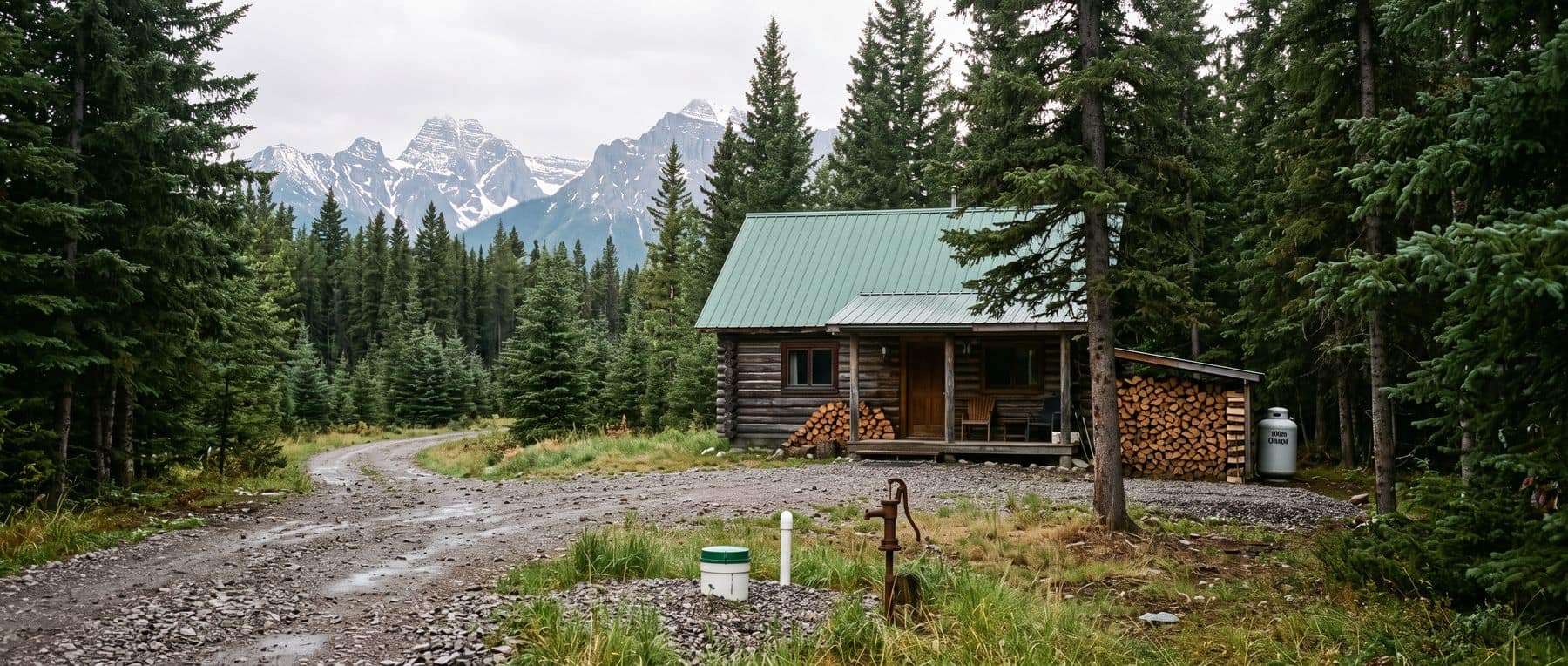
- Canmore's residential land use districts have minimum lot areas between 230 m² and 800 m², roughly a twentieth to a fifth of an acre (Land Use Bylaw 2018-22).
- The only Canmore district with acreage-scale parcels is Future Development, minimum 16 hectares, and a dwelling is not among its permitted or discretionary uses.
- The MD of Bighorn replaced Land Use Bylaw 09-Z/18 with Bylaw 10-26 on 13 July 2026, cutting 32 districts to 18 and keeping acreage districts in the Ghost River area, not beside Canmore.
- In Harvie Heights and Lac des Arcs the minimum parcel is 990 m² and subdivision is limited to boundary adjustment, so no new lots are created there.
- Anything on private services needs a well under the Water Act household right (1,250 m³ a year, no licence) and a septic system built to the Alberta Private Sewage Systems Standard of Practice 2021.
- Over two-thirds of Kananaskis Country is provincial park, and the rest is public land use zones, so none of it is for sale.
Searching for Canmore acreages for sale turns up plenty of listings with mountain views and almost none with acres attached. The town sits on 68.47 square kilometres of land (Statistics Canada, 2021 Census), most of it either built, zoned for conservation, or held as wildlife corridor. This post sets out what the Town's own bylaw allows, where genuine acreage-scale land in the Bow Valley actually sits, who governs it, and what a rural parcel costs to service before you have poured a foundation.
Do Canmore acreages for sale actually exist?
Inside the town boundary, no. The Town of Canmore Land Use Bylaw 2018-22 sets the minimum lot area for every detached residential district in hundreds of square metres, not hectares:
| District | Minimum lot area | Roughly |
|---|---|---|
| R1B Residential Detached Plus | 230 m² | 0.06 acre |
| R1A Residential Detached Small-Lot | 400 m² | 0.10 acre |
| R1 Residential Detached | 460 m² (maximum 920 m²) | 0.11 acre |
| R1B-W Residential Detached Plus Wide Lot | 800 m² | 0.20 acre |
| FD Future Development | 16.0 hectares | 39.5 acres |
R1 is the closest thing Canmore has to a conventional suburban lot, and the bylaw caps it at 920 m². The single district measured in hectares is Future Development, whose stated purpose is to hold land "potentially suited for future urban uses". Its permitted use is a public utility; its discretionary uses run to extensive and intensive agriculture, outdoor recreation, campgrounds and public buildings. A dwelling is not on either list. So the one place in Canmore where you can hold 40 acres is also the one place you cannot live.
The remaining large parcels are zoned Environment, Natural Park or Conservation of Wildlands, where the permitted uses are wildlife corridor, wildlife habitat patch and open space. That is the whole answer to why acreages do not appear on the Canmore market: the bylaw never made room for them, and no rezoning application is going to create them.
Listings sometimes describe a 900 m² Canmore lot as an acreage or a "rare large parcel". It is a fifth of an acre. If you want horses, a shop, a second driveway or a treed buffer between you and the neighbours, the Canmore land use districts will not deliver it at any price. Read the district on the tax roll before you read the marketing, and if the zoning letters mean nothing to you, start with our guide to the Canmore Land Use Bylaw for buyers.
Where acreage-scale land in the Bow Valley really is
Canmore is surrounded on every side by land that is not for sale. Banff National Park is federal. Bow Valley Wildland and the ranges above town are provincial. The approved wildlife corridor along the eastern edge is a planning constraint that no amount of money removes. Further south and west, Alberta Parks describes Kananaskis Country as a patchwork of provincial parks and public land use zones, with over two-thirds of it established as park under the Provincial Parks Act or the Wilderness Areas, Ecological Reserves, Natural Areas and Heritage Rangelands Act. Crown land in that condition is not sold to private buyers.
What is left is the Municipal District of Bighorn, the rural municipality that wraps around Canmore and governs Harvie Heights, Dead Man's Flats, Exshaw and Lac des Arcs. That is where acreages exist, and the honest qualifier is that most of the real acreages sit a long way east of Canmore rather than next door to it.
What the MD of Bighorn's Land Use Bylaw 10-26 permits
The MD rescinded Land Use Bylaw 09-Z/18 and replaced it with Bylaw 10-26 on 13 July 2026, cutting the number of land use districts from 32 to 18 and introducing a three-stream development permit system (Rocky Mountain Outlook). The districts that matter to an acreage buyer:
- Country Residential (CR)
- 0.4 – 1.2 ha
- Ghost River, Scott Lake, Ghost Reservoir; Scott Lake 0.6–1.6 ha
- Small Holdings (SH)
- 4.2 ha minimum
- Jamieson Road area; max four parcels per quarter section
- Agriculture Conservation (AC)
- 1.2 – 4.05 ha
- residential use; max two parcels per quarter section
- Hamlet Residential Unserviced (R-1)
- 990 m²
- Harvie Heights and Lac des Arcs; boundary adjustment only
Two things follow from that table. First, the districts that produce real acreages, Country Residential and Small Holdings, are in the Ghost River country in the east of the municipality. The MD's own Jamieson Area Structure Plan describes roughly 5,200 hectares of small-holdings land south of Highway 40 and the Summer Village of Waiparous, north of Ghost Lake. That is a different valley from Canmore, with a different commute and a different feel.
Second, the four hamlets closest to Canmore are not acreage country. Harvie Heights and Lac des Arcs sit in the R-1 Hamlet Residential Unserviced district at a 990 m² minimum, and the bylaw answers "Is subdivision allowed?" with "boundary adjustment only". Benchlands, the MD hamlet on the Ghost River, is listed as existing parcels with no further subdivision. If you want a hamlet lot within minutes of Canmore, read homes for sale near Canmore and Harvie Heights real estate instead of searching for acreages.
The large blocks in between are districted Forest Area, whose stated purpose is the conservation of extensive areas "primarily owned by the Crown" where development is limited by topography, soil, vegetation, wildlife, inaccessibility and watershed conservation. Zoning a parcel Forest Area is a polite way of saying nobody is building there.
Why subdivision is hard, even when you own the land
Owning a quarter section in the MD does not entitle you to carve it up. Bylaw 10-26 puts hard parcel counts on the rural districts: two parcels per quarter section in Agriculture Conservation, four in Small Holdings. Country Residential subdivision must follow an adopted area structure plan, and the Ghost Reservoir lands are governed by the McDermid Area Structure Plan, which allows a 26.02-hectare site to be split into two 10-hectare lots or up to eight bareland condominium units of at least one hectare each.
On top of the district rules sit the provincial layers: the subdivision authority under the Municipal Government Act, environmental reserve requirements along watercourses, and a development permit application that can be asked for a servicing statement covering the supply of potable water and the disposal of wastewater, a stormwater management plan, a topographical survey and a reclamation plan. None of that is unusual for rural Alberta. It does mean the timeline for creating a new acreage is measured in years, which is why the supply barely moves.
Servicing an acreage: well, septic, power, access
Acreages in the MD are on private services, and the four cost lines are worth pricing before you offer.
Water. Alberta's Water Act gives a household a statutory right to divert up to 1,250 cubic metres a year without a licence, provided the land adjoins a watercourse or has groundwater beneath it and the household is not entitled to receive water from a municipal or co-op source. The water may only be used for human consumption, sanitation, fire prevention and watering animals, gardens, lawns and trees. More than 450,000 Albertans drink from a groundwater well (Environment and Protected Areas, June 2024). What the Act does not do is guarantee you find water at a workable depth or a workable flow rate. Ask for the well record, the drilling log and a recent flow and potability test.
Sewage. A private sewage disposal system needs a permit, and since 1 November 2022 designs and installations have had to meet the Alberta Private Sewage Systems Standard of Practice 2021. Older systems on older parcels are frequently not to that standard. A failed field on a small parcel with poor soils is one of the few problems money cannot always solve.
Power and access. Bringing a service line any distance is a line item most first-time rural buyers underestimate. So is a private road: grading, culverts, dust control and winter clearing all fall on the owner or a road association, not on a municipal crew. The MD's building setbacks from a private sewage system, and the bylaw's requirement that surfaces not generate dust, both shape where a house can actually go.
The right order on any rural Bow Valley parcel is services, access, then view. A well record and a septic permit history take a phone call and settle most of the risk. A parcel that has never had a permitted system, or whose well log is missing, is not a bargain, it is a construction project with an unknown budget. The same discipline applies to older recreational stock, which is covered in the guide to buying a cabin in the Bow Valley.
The alternative most buyers land on
Buyers who start by searching for acreages for sale usually end up in one of three places. Some buy a hamlet lot in the MD and accept a fifth of a hectare with mountains behind it. Some buy the largest R1 lot they can find in Canmore, up to that 920 m² cap, and put the budget into the house instead of the land; the practicalities are in building a house in Canmore. Some drive east and buy a genuine acreage in the Ghost River country, trading twenty extra minutes on the highway for the space they wanted in the first place.
There is also a small amount of genuine land for sale in Canmore at conventional lot scale, and it is worth watching, because serviced infill lots inside the town boundary are scarcer than the houses on them. Whichever route you take, run the carrying costs through the buyer cost calculator before you commit, because a rural parcel adds well, septic, road and power lines that a serviced Canmore lot does not.
What this means if you're buying
If you came here looking for Canmore acreages for sale, the useful conclusion is that the search term describes a product the town does not zone for. Decide which part of "acreage" you actually want. If it is privacy and a shop, look at MD of Bighorn Country Residential and Small Holdings parcels in the Ghost River area and price the well, the septic system and the road. If it is proximity to Canmore, accept hamlet-scale land in Harvie Heights or Lac des Arcs, where the minimum parcel is 990 m² and no new lots are being created. And if it is the view, buy the best-oriented lot in town and stop paying for acres you will never be allowed to have.
The practical takeaway is that Canmore acreages for sale sit in the MD of Bighorn or nowhere, so decide early whether it is space, privacy or the view you are really buying. For where this property type fits in the wider market, start with homes for sale in Canmore.
Fifteen minutes with a local REALTOR® on what the district actually permits, what servicing a rural parcel costs, and which nearby options are worth a drive. Free, no obligation.
Frequently asked
Are there acreages for sale in Canmore, Alberta?
Not in any meaningful sense inside the town boundary. Canmore's Land Use Bylaw 2018-22 sets minimum lot areas of 460 m² in R1, 400 m² in R1A, 230 m² in R1B and 800 m² in the widest single-family district, R1B-W. The only district that deals in hectares is Future Development, at a 16-hectare minimum, and it does not list a dwelling as a permitted or discretionary use.
Where can you buy an acreage near Canmore?
In the Municipal District of Bighorn, which surrounds Canmore. Under Bylaw 10-26 the Country Residential district covers Ghost River, Scott Lake and Ghost Reservoir, with minimum parcels of 0.4 hectares at Ghost River and 0.6 hectares at Scott Lake, and the Small Holdings district covers the Jamieson Road area at a 4.2-hectare minimum. Both sit in the Ghost River country in the east of the municipality, not on Canmore's doorstep.
Can you buy land in Kananaskis Country?
No. Alberta Parks describes Kananaskis Country as a mix of provincial parks and public land use zones, with over two-thirds established as park under the Provincial Parks Act or the Wilderness Areas, Ecological Reserves, Natural Areas and Heritage Rangelands Act. It is Crown land held for recreation and conservation. There is no private freehold to buy there.
Can you subdivide an acreage near Canmore?
Rarely, and never as of right. In the MD of Bighorn's Agriculture Conservation district the bylaw caps parcels at two per quarter section; Small Holdings allows four. In the hamlets of Harvie Heights, Lac des Arcs and Benchlands, R-1 subdivision is limited to boundary adjustment only. Country Residential subdivision has to follow an adopted area structure plan.
What services does an acreage outside Canmore need?
Almost always a private well and a private sewage system. Alberta's Water Act gives a household the right to divert up to 1,250 cubic metres a year without a licence, for drinking, sanitation, fire prevention and watering. Septic work must meet the Alberta Private Sewage Systems Standard of Practice 2021, mandatory for permits since 1 November 2022. Power, road access and snow clearing are the other three costs to price.
Why is there so little private land around Canmore?
Because most of the land is not available to buy. Canmore is bounded by Banff National Park, provincial parks and wildland, and an approved wildlife corridor, and its own bylaw zones the undeveloped edges as Environment, Natural Park and Conservation of Wildlands. The one large block of developable private land inside town is the Three Sisters lands.
- Town of Canmore: Land Use Bylaw 2018-22 (revised consolidation)
- Municipal District of Bighorn: Land Use Bylaw
- Rocky Mountain Outlook: MD of Bighorn land use bylaw overhaul heads to public hearing
- MD of Bighorn: Jamieson Area Structure Plan
- Alberta Parks: Kananaskis Country park management
- Government of Alberta: Accessing water for household purposes in Alberta (June 2024)
- Alberta.ca: Private sewage codes and standards
- Statistics Canada: Census Profile 2021, Canmore, Town
Keep reading

Tell us what you’re looking for and get a straight answer, usually the same day. Free, and no obligation.