Canmore Perpetually Affordable Housing: Who Qualifies
How Canmore Perpetually Affordable Housing, now called Vital Homes, works: who qualifies, what the homes cost, the resale formula and the waitlist.
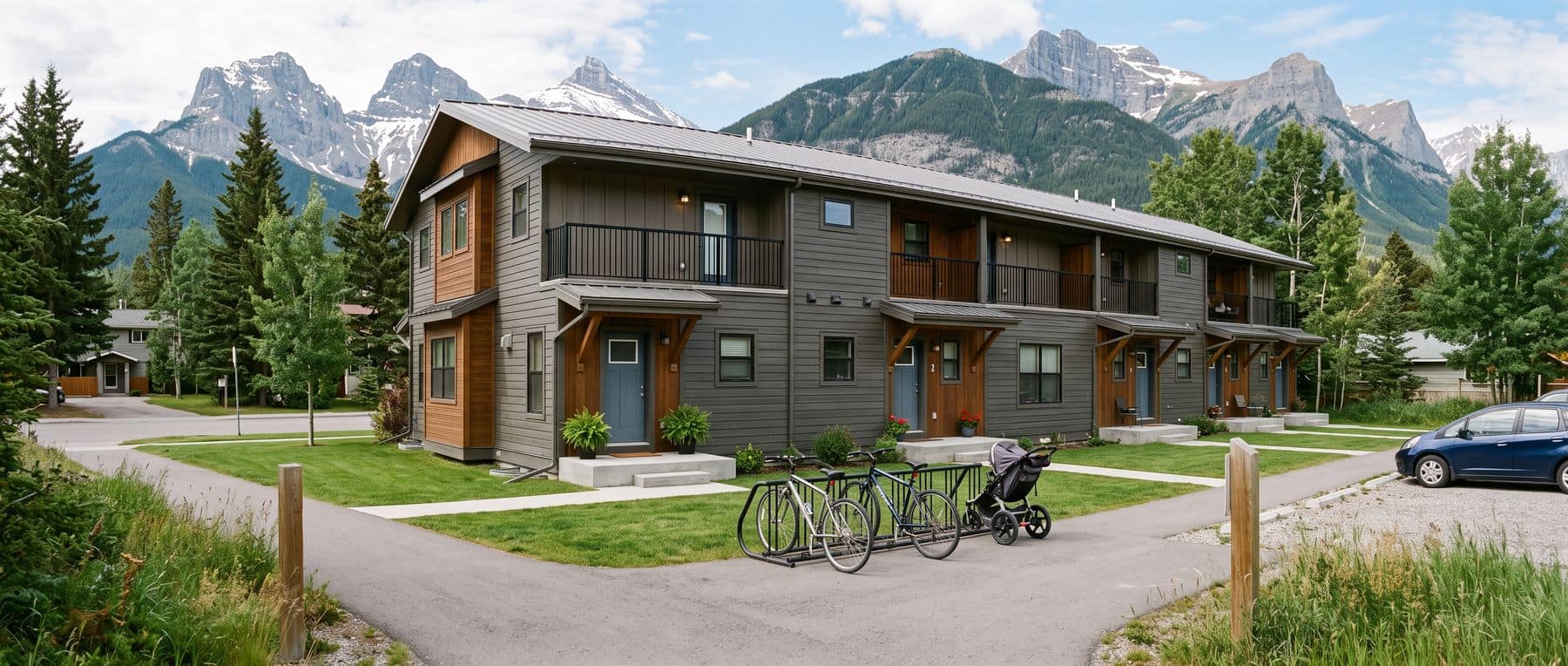
- PAH and Vital Homes are the same program. CCH, a non-profit wholly owned by the Town, has 197 ownership units and 108 rental units, with 144 more rentals under construction at 100 Palliser Trail.
- Eligibility is about connection to Canmore, 30 hours a week of local work for six months, a year of residency plus local work, or five years of residency, and income of $250,000 or less.
- Recent Vital Homes resales and new units have closed between roughly $304,000 and $358,000 for two-bedroom condos and townhomes (CCH, 2025–26).
- You buy a leasehold interest with a restrictive covenant: primary residence only, annual declaration, resale price capped by an inflation-indexed formula.
- Getting on the waitlist takes an information session, a lender pre-qualification letter, an online application and a statutory declaration.
Canmore Perpetually Affordable Housing is the one route to ownership in town that does not start at seven figures. Run by Canmore Community Housing (CCH) under the name Vital Homes since 2020, it sells homes to eligible local households at a fraction of market price: recent two-bedroom units have closed between roughly $304,000 and $358,000, in exchange for restrictions on who can buy, how the home is used and what it can be resold for. This post covers how the program works, who qualifies, what resale looks like and how to get on the list. It belongs alongside the first-time buyers guide.
What is Canmore Perpetually Affordable Housing?
CCH is a non-profit corporation wholly owned by the Town of Canmore, established in 2000 to provide "below market" housing for the people who work here. In September 2020 it renamed the Perpetually Affordable Housing (PAH) program Vital Homes; the program itself did not change, and the Land Use Bylaw still uses the PAH term. It is not subsidized social housing. That is Bow Valley Regional Housing’s role, but a price-restricted ownership and rental portfolio funded by the Vital Homes property tax levy, developer contributions and, from 2026, Livability Tax revenue.
- Ownership units in the portfolio
- 197
- CCH, August 2026
- Rental units
- 108
- The Hector (60) and McArthur Place (48)
- Under construction
- 144 rentals
- 100 Palliser Trail
- Income cap for ownership
- $250,000
- gross household, previous tax year
Rental rates are set at least 10% below market: in 2026 The Hector at Palliser Village lists studios at $1,050 and two-bedrooms at $1,725 a month with heat, water, sewer and garbage included, and McArthur Place in Three Sisters lists one-bedrooms from $1,350 (CCH current listings).
Who is eligible for Vital Homes ownership?
Eligibility is about connection to Canmore and need, not about being a first-time buyer. You must be a Canadian citizen or permanent resident, meet one of three pathways, and stay under the income cap.
| Pathway | Requirement |
|---|---|
| Canmore permanent employee | Working at least 30 hours a week in permanent employment with a licensed Canmore business for at least six months |
| Canmore employment and residency | Lived in Canmore for at least 12 months before possession, and either employed locally 20+ hours a week for six months, self-employed with a Canmore business licence for six months, or retired with 60 months of Canmore work in the ten years before retirement |
| Long-term Canmore resident | Currently living in Canmore with at least 60 months of residency, cumulative or consecutive, within the last ten years |
| All pathways | Gross household income of $250,000 or less on line 15000 of the previous year’s notice of assessment; the home must be your permanent and primary residence; you must qualify for mortgage financing |
There is no asset test published on CCH's eligibility page, which sets out citizenship or permanent residency, the household income cap and the Canmore employment or residency route. The application itself asks for supporting documentation and a sworn statutory declaration, so if you own property elsewhere, raise it with CCH before you apply rather than after.
What do Vital Homes cost, and how does resale work?
The "perpetually" in Perpetually Affordable Housing describes the resale side, not just the entry price. Prices are kept below market through what CCH calls "market restriction and our resale formula." Most homes are sold as a leasehold interest, a 100-year lease on new builds, or the remaining term on resales, coupled with a restrictive covenant and option agreement registered on title. Those instruments give CCH three rights: the home must stay the owner’s primary residence, the resale price is restricted by a formula indexed to inflation, and CCH has an option to purchase when the owner wants to sell. Owners sign an annual primary-residence declaration. CCH states the formula plainly: the leasehold interest binds the future resale of the property to 110% of the Consumer Price Index, compounded annually from the original purchase price.
Recent CCH sales give a sense of the price level. These are the prices actual Vital Homes units changed hands at, building by building, against a median assessed condo of about $800,000 in 2026:
| Building | Unit type | Price |
|---|---|---|
| Mineside Court, Rundle Drive | Two-bedroom | $318,049 |
| Mineside Court, Rundle Drive | Two-bedroom | $313,212 |
| Wolf Willow, Dyrgas Lane | Two-bedroom | $303,844 |
| Mountainside Villas, Peaks of Grassi | Two-bedroom, 2.5-bath townhome | $357,500 |
| Altitude, Three Sisters Mountain Village | New one- or two-bedroom | $352,000 |
| Altitude, Three Sisters Mountain Village | New one- or two-bedroom | $328,000 |
The Ptarmigan Pointe townhomes in Stewart Creek in Canmore, two- and three-bedroom units of 829 to 1,709 square feet, sold entirely to the waitlist, which is the usual pattern: units rarely reach a public listing.
- Entry price around a third of the median assessed condo (about $800,000 in 2026)
- Rents at least 10% below market with utilities largely included
- Homes are new or well-located resale condos and townhomes, pet friendly
- Lenders familiar with the program exist and CCH will refer you
- Predictable, inflation-indexed equity growth without market swings
- Appreciation is capped; you do not share in Canmore’s market gains
- Leasehold tenure plus a covenant and option on title. Some lenders will not finance it
- Primary residence only, declared annually; no nightly or investment rental
- Resale must go through CCH to an eligible buyer, which can take longer than a market sale
- Waitlists are long and units are released in small numbers
How do you apply for Vital Homes?
- 1Attend an ownership information sessionOnline, monthly, usually the first or second Wednesday at 12:05 p.m. Register by emailing programs@canmorehousing.ca.
- 2Get a mortgage pre-qualification letterCCH keeps a list of banks and brokers who understand leasehold Vital Homes financing. This step tells you whether you can buy now or should join the waitlist for later.
- 3Gather documents and apply onlineEmployment letters, residency proof, the previous year’s notice of assessment and ID, submitted through CCH’s online application system.
- 4Sign the statutory declarationOnce CCH verifies your file, you sign a sworn declaration at their office. A 10 to 15 minute appointment, and join the waitlist.
- 5Wait, and renew your eligibilityUnits are offered in waitlist order. Existing members complete eligibility renewals online.
Some Canmore buildings were marketed with an "attainable housing" model, CCH notes the Blakiston is a market condominium and the Vue and Rundle House are market rentals, none of them CCH properties. Only homes with CCH’s covenant on title are Vital Homes, and only waitlist households can buy them, if a listing quotes a PAH-like price with no CCH involvement, ask what restriction, if any, is actually registered on the title.
Where do new Canmore perpetually affordable housing units come from?
Three sources. First, CCH’s own developments on Town-owned land, such as 100 Palliser Trail and Ptarmigan Pointe. Second, the Land Use Bylaw’s density bonus: under section 12, a developer who provides one PAH unit on site may build three additional market units (two for off-site units), and the Canmore Planning Commission can grant variances of up to 30% for PAH projects. Third, developer commitments in the big plans: Three Sisters Mountain Village agreed to a minimum of 10% affordable units with up to 20% through bonusing, and Spring Creek Mountain Village provides 5% (CBC, April 2026). The Town says it plans to add more than 1,000 affordable units over the next 10 to 20 years, and the Three Sisters guide tracks where they land.
A local REALTOR®’s standing advice to local renters: apply to the Vital Homes waitlist as soon as you meet a pathway, even if buying is two years away. CCH itself encourages it, the position is what matters, and the monthly information session is the fastest way to find out whether your income and employment history fit before you spend money on anything else. Read the cost of living in Canmore figures alongside it.
What this means if you’re buying
If you live and work in Canmore, earn under $250,000 as a household and cannot see a path to a $800,000 condo, Canmore’s perpetually affordable housing, the Vital Homes program, is the route to test first: attend a session, get pre-qualified with a lender who knows leasehold, and get on the list. Go in understanding the trade. You are buying stability and a below-market price, not Canmore’s appreciation, and that the home has to be where you actually live. If you are an investor or a second-home buyer, PAH is closed to you by design; the cheap houses in Canmore post is the honest look at what the open market offers below $500,000, and the housing shortage post explains why the list is long.
Canmore perpetually affordable housing rewards patience: meet a pathway, get on the list early, keep your eligibility current, and take the unit that comes up. The Canmore property tax page has the worked examples and the due dates.
Fifteen minutes with a local REALTOR® to compare Vital Homes and the open market for your budget and timeline. Free, no obligation.
Frequently asked
What is Perpetually Affordable Housing in Canmore?
A program run by Canmore Community Housing (CCH), the Town-owned non-profit established in 2000, that sells and rents homes below market to eligible local residents and keeps them affordable for the next buyer through resale and rent formulas. It was renamed the Vital Homes program in September 2020; the rules did not change.
Who qualifies for Vital Homes ownership in Canmore?
Canadian citizens or permanent residents on one of three pathways: permanent employment of 30 or more hours a week with a licensed Canmore business for six months; 12 months of Canmore residency plus 20 or more hours a week of local work, self-employment, or retirement after five years of local work; or 60 months of residency within the last ten years. Gross household income must be $250,000 or less on line 15000 of last year’s notice of assessment.
How much does a PAH home cost in Canmore?
Well below market. CCH’s recent listings show two-bedroom condos and townhomes sold between $303,844 and $357,500, and new one- and two-bedroom units at Altitude in the Three Sisters village plan area at $352,000 and $328,000. For comparison, the Town put the median assessed condo at about $800,000 in 2026.
Can I sell a Vital Homes unit at market value?
No. The resale price is set by a formula indexed to inflation, CCH holds an option to purchase when you sell, and the buyer must be an eligible household from the waitlist. You build equity through your mortgage payments and the capped appreciation, not through Canmore’s market gains.
Can I rent out a Vital Homes property?
Not as a rental property. The home must remain your permanent and primary residence, confirmed by an annual declaration; CCH investigates complaints and enforces the requirement. Housemates and boarders are permitted if a titled owner continues to live there. Nightly rental is not allowed.
- Canmore Community Housing: Looking to Own: Vital Homes eligibility and application steps
- Canmore Community Housing: About us (program history, leasehold tenure, portfolio, FAQs)
- Canmore Community Housing: Housing Programs (Vital Homes overview, resale formula)
- Canmore Community Housing: Current Listings (recent Vital Homes sale prices and rents)
- Town of Canmore: Revised Land Use Bylaw 2018-22, Section 12 PAH Regulations (PDF)
- CBC: Alberta government proposes new laws to rein in Canmore vacancy tax (affordable housing context)
Keep reading

Tell us what you’re looking for and get a straight answer, usually the same day.