Canmore Hotel Condos for Sale: How They Actually Work
What a Canmore hotel condo for sale really is: the 30-day occupancy rule, rental pools, the financing problem, commercial tax and what the 800 new units coming mean for returns.
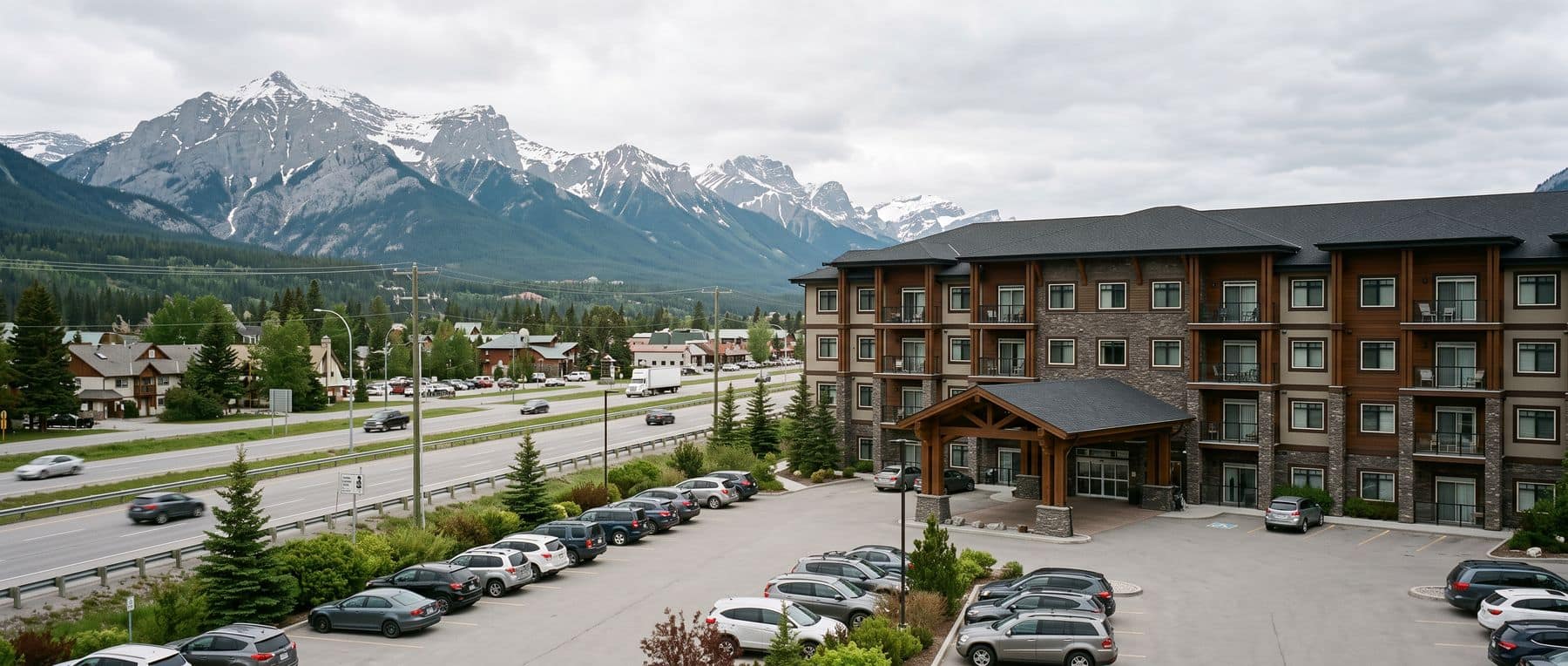
- Hotel condos are visitor accommodation, not residential: no permanent occupancy, ever.
- Many titles from the mid-2000s carry a registered 28-day occupancy restriction; Council has repeatedly refused to remove it.
- Taxed commercially at 0.957% of assessed value in 2026. The highest of Canmore's four rates.
- Financing tightened after 2008 and remains the main reason these units trade below residential product.
- The Town expects more than 800 new visitor accommodation units within three to four years, mostly along Bow Valley Trail.
A Canmore hotel condo looks like the cheapest way into the nightly-rental market, and on a price-per-square-foot basis it usually is. The catch is what you are actually buying: a unit in a visitor-accommodation building that you are not permitted to live in, financed on terms closer to Canmore commercial real estate than residential, and taxed at the highest rate the Town levies. For the right investor that trade works. For a buyer who imagined eventually retiring into it, it does not.
What you are buying in a Canmore hotel condo for sale
The Town's definition of visitor accommodation is unambiguous: "a building or group of buildings not for residential use, rather only for short-term stays where sleeping facilities are provided for visitors for periods of up to 30 days." Long-term residency is not permitted, and the building must have a centralised booking system.
Canmore's condo-hotel stock was largely developed through the mid-2000s along Kananaskis Way in Canmore and the Bow Valley Trail corridor. To guarantee those units stayed in visitor use, titles were registered with a restricted length of occupancy, commonly 28 days. Owners have pressed Council to remove those restrictions, particularly after post-2008 financing problems, and Council has repeatedly rejected rezoning applications that would have done so.
If you are still weighing designations, tourist home vs residential vs visitor accommodation compares all three, and can you Airbnb in Canmore sets out the licence rules that apply once you own one.
How the income works
Most owners earn through a rental pool. The Canada Revenue Agency describes the standard arrangement well: a management company is hired to rent the property on the owner's behalf and to provide hotel-type services such as reservations, housekeeping and front desk, with owners notifying the manager when they intend to use the unit themselves.
The Canmore market has been shifting away from that model. The Town's manager of economic development told Council in 2024 that there is "a growing shift in purpose-built visitor accommodations, so condo hotels where initially they were all operated by one management company to now having individual owners operate and manage their own units."
That shift is why the business licence rules changed. Since September 2025, individually titled visitor accommodation units need their own licence, $150 a year, or $40 for micro-operators under $30,000 in revenue. At the time Council approved it, 1,452 visitor-accommodation tax rolls were covered by only 389 licences.
Pool agreements vary enormously on the things that decide your return: the management split, how bookings are allocated between units, blackout periods for owner use, who pays for refurbishment cycles, and whether you can leave the pool. Two units in the same building can produce very different net income under different agreements. Ask for the agreement, the last two years of owner distributions and the reserve fund study before you go firm.
The four things that decide the return
- 1Tax classCommercial. The 2026 non-residential total rate is 0.00957275 of assessed value: about $4,786 a year on a $500,000 assessment, and higher than the tourist home rate of 0.832%.
- 2FinancingPost-2008 lending changes made these units difficult to finance conventionally. Expect a larger down payment, possibly commercial terms, and fewer lenders. Get a licensed mortgage broker involved before you write.
- 3FeesCondo fees in hotel-style buildings cover pools, hot tubs, fitness rooms, lobbies and elevators, and are typically well above residential condo fees. Check the reserve fund study, hospitality finishes wear faster than residential ones.
- 4GSTPurchases of previously occupied units placed in rental pools are generally taxable. Registering lets you claim input tax credits, but it also makes your eventual sale taxable. Take accounting advice before closing, not after.
The GST question, properly
The CRA's guidance on vacation properties is the document to read before you buy one of these. In short: the purchase of a previously occupied vacation property is taxable where the property is not used primarily as the vendor's residence and 90% or more of rentals are for periods under 60 days, which describes almost every unit in a rental pool.
If you register for GST before purchase and use the unit exclusively for taxable short-term rentals, you may claim a full input tax credit on the purchase. Mixed personal and rental use reduces that credit proportionally, and buying primarily for personal use eliminates it. What owning a vacation home here costs to hold, against what the same weeks cost to rent, is a separate calculation worth doing first. A later change in use of 10% or more triggers a recalculation. And the sale of a unit you claimed credits on is itself taxable.
The CRA's own worked examples show owners who assumed every day they were not personally in the unit counted as commercial use, and who then had to repay input tax credits. Canmore has real seasonality, August is the strongest revenue month and November the weakest, so a plan built on renting 330 nights a year is not credible. Model the nights that will actually book.
Supply is the risk worth watching
Tourist-home supply is capped. Visitor-accommodation supply is not. The Town expects more than 800 new visitor accommodation units within three to four years, on top of roughly 1,500 existing ones. Recent approvals along Bow Valley Trail include a 156-unit, four-building development at 300 William Street approved in May 2026, and a run of 74 to 101-unit projects on Bow Valley Trail and Kananaskis Way over the past several years.
More rooms competing for the same visitors puts pressure on nightly rates. AirDNA's Canmore average daily rate was down 5.1% year over year as of July 2026 even as occupancy rose. That is the pattern you would expect from supply growth, and it argues for underwriting conservatively rather than extrapolating recent revenue growth.
Hotel condo, tourist home or residential condo
The three ways to own a Canmore condo price closer together than most buyers expect, so the decision turns on what each one lets you do rather than on the entry cost. Hotel condos for sale in Canmore averaged $978,000 in 2025, up 15% on the year, which was marginally above the average tourist home and above the average residential apartment condo.
| Hotel condo (visitor accommodation) | Tourist home | Residential apartment condo | |
|---|---|---|---|
| 2025 average sold price | $978,000, up 15% | $960,000, up 6% | $814,000, up 8% |
| 2026 property tax rate | 0.957% | 0.832% | 0.457% primary, 0.833% non-primary |
| Live in it year round | No | Yes | Yes |
| Rent it nightly | Yes, business licence required | Yes, business licence required | No |
| Typical financing | Commercial or alternative lending, larger down payment | Lender practice of 25% to 35% down | Standard residential terms |
Prices are 2025 year-end averages from the canmorealberta.com annual review, and the rates come from the Town's 2026 Rate of Taxation Bylaw. The pattern is the one to hold on to: the cheapest tax class is the one you can live in, and the dearest is the one you cannot.
What this means if you're buying
A Canmore hotel condo for sale suits an investor who wants exposure to Canmore's visitor economy, accepts commercial tax and financing, and has no interest in ever occupying the property beyond a few weeks a year. It does not suit a buyer who wants a future home, flexibility between nightly and long-term tenants, or a straightforward mortgage. That buyer should be looking at tourist homes for sale instead, and at the buildings that already carry nightly-rental rights, paying the premium for the flexibility. Whichever way you go, get the rental pool agreement, the reserve fund study and a mortgage pre-approval in hand before you commit, and test the numbers in the tourist-home ROI calculator. Financing specifics are covered in financing a short-term rental in Canmore. The newest visitor-accommodation building on the corridor is Ascent at 1730 Bow Valley Trail, Canmore AB, completed in 2025.
We will put the two side by side on tax, fees, financing and realistic net income. Free, no obligation.
Frequently asked
What is a hotel condo in Canmore?
An individually titled unit inside a visitor-accommodation building, a condo-hotel. The Town defines visitor accommodation as buildings not for residential use, providing sleeping facilities for visitors for periods of up to 30 days, with a centralised booking system. Most are along Kananaskis Way and Bow Valley Trail.
Can you live in a Canmore hotel condo?
No. Residential occupancy is not permitted. Stays are capped at 30 days under the Land Use Bylaw and many units built in the mid-2000s carry a registered occupancy restriction of 28 days on title, put there specifically to keep the units in visitor use.
How does a hotel condo rental pool work?
A property management company markets and books the unit, handles housekeeping and front-desk services, and distributes income to owners under a pool agreement. Owners notify the manager when they intend to use the unit themselves. Some Canmore complexes allow self-management or an owner's choice of manager instead.
Are hotel condos hard to finance in Canmore?
Harder than residential. Banking practice changes after 2008 created challenges for buyers of these units, and the difficulty prompted owners and developers to press Council for rezoning. Expect larger down payments, commercial or alternative lending, and shorter amortisations. Speak to a licensed mortgage broker early.
How are Canmore hotel condos taxed?
In the commercial, non-residential class, which is the highest of Canmore's four 2026 rates. The total rate is 0.00957275 of assessed value, about $4,786 a year on a $500,000 assessment. That sits above the tourist home rate of 0.832% and well above the 0.457% a primary residence pays. Council sets the rates each May and the bill is due the last business day of June.
- Town of Canmore: Accommodation Types
- Town of Canmore: Tax Rates (2026 Rate of Taxation Bylaw)
- Rocky Mountain Outlook: Understanding the future of visitor accommodation for Canmore
- CBC: Canmore to require business licences for short-term rentals
- canmorealberta.com: Canmore Real Estate 2025, a Return to Balance
- CRA: GST/HST and the Purchase, Use and Sale of Vacation Properties by Individuals (GI-025)
Keep reading

Tell us what you’re looking for and get a straight answer, usually the same day. Free, and no obligation.
Nightly rate, occupancy, management fees, tourist-home tax and financing, cash flow, cap rate and break-even in one place.
Tourist-home ROI calculator