Bow Valley Trail Canmore Real Estate
Bow Valley Trail is Canmore’s hotel-condo and tourist-home corridor. Here is how the units work, what they cost, the fees, revenue pools and taxes, and who should and should not buy one.
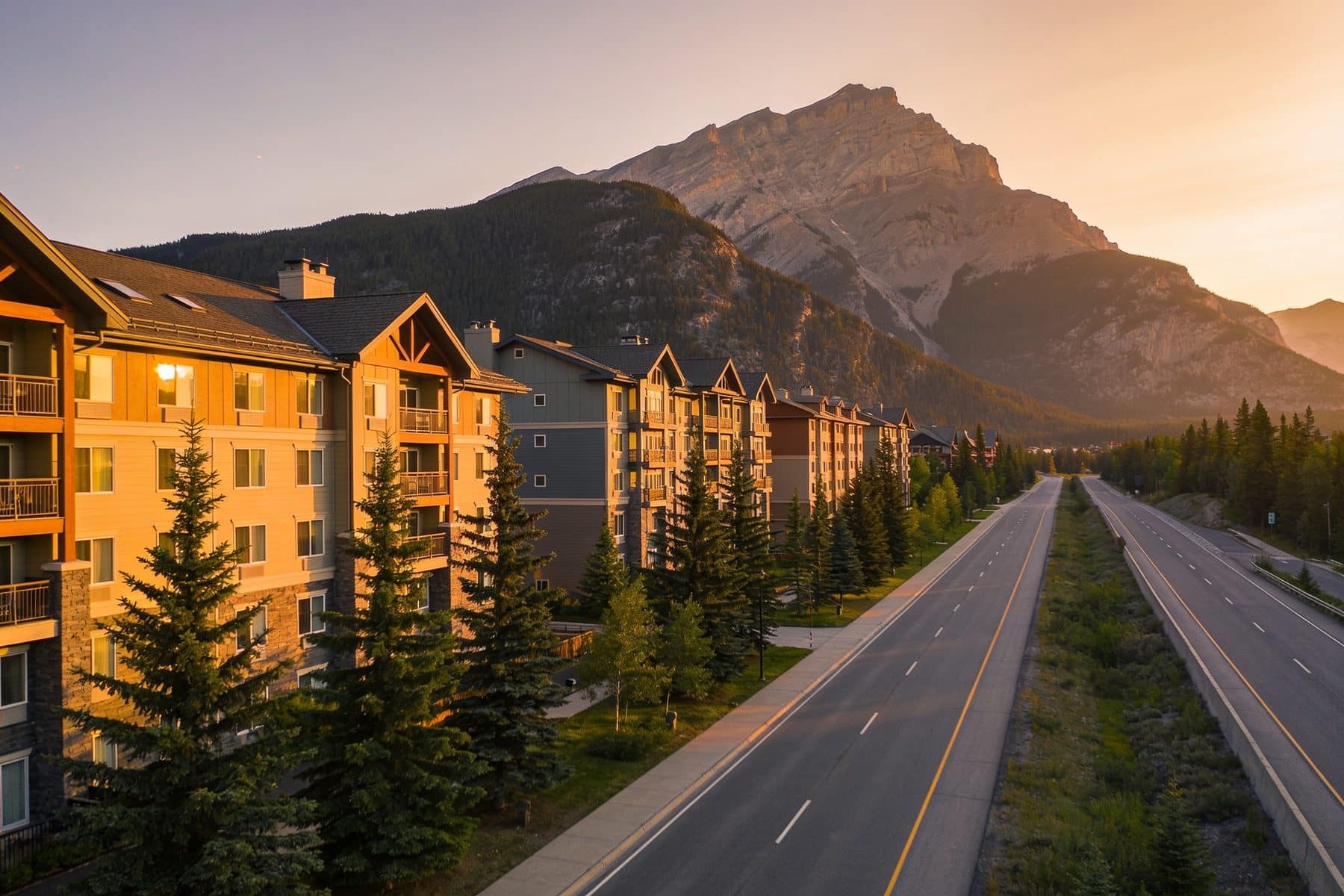
- Sun exposure
- valley floor
- Short-term rentals
- tourist-home & hotel-condo corridor
- Property mix
- Hotel condos, tourist-home buildings and commercial
- Suits
- Investors
- Bow Valley Trail is planned as one of the Town’s primary visitor-accommodation areas; residential use is deliberately limited to a minority of floor space.
- A hotel condo (visitor accommodation) can host guests for up to 30 days at a time but cannot be your home; a tourist home can do both. Since March 11, 2025 no new tourist homes can be created on the corridor.
- Rental pools historically kept 45–50% of gross revenue; owners who self-manage after the 2014 court ruling typically pay 20–25% to a manager (CREB, 2020).
- Add the non-residential tax rate, the 6% Alberta tourism levy (from April 1, 2026), GST and hotel-level condo fees before you believe a projected yield.
Bow Valley Trail Canmore is where most of the town’s nightly-rental real estate lives: the commercial strip along the north side of the Trans-Canada where the Town has, on purpose, concentrated hotels, condo-hotels and tourist homes. This page explains what the corridor is for, the three kinds of unit you can buy, how hotel condos and rental pools actually work, and the fees, taxes and levies that decide whether the numbers work.
Bow Valley Trail Canmore: where the corridor sits and what it is for
Bow Valley Trail runs parallel to the highway from the Benchlands Trail interchange east through the hotel district, with Kananaskis Way, Mountain Avenue and William Street as side streets. The Town’s Area Redevelopment Plan (Bylaw 11-2012) sets the vision plainly: the area is “one of the Town’s primary visitor accommodation areas”. Residential use is ancillary, capped at 50% of a building’s floor area, kept off the ground floor and limited to units of 75 m², with exceptions for employee housing and affordable housing.
Approvals keep coming: a 156-unit visitor accommodation project at 300–320 William Street was approved in May 2026. Teepee Town, Canmore is the residential grid immediately south; Spring Creek is the closest condo neighbourhood with a residential feel.
Hotel condo vs tourist home vs residential: what you can actually buy here
| Unit type | Who can stay | Can you live there? | Nightly rental | Tax class |
|---|---|---|---|---|
| Hotel condo (visitor accommodation) | Guests for up to 30 days; centralized booking | No: not zoned for residential use | Yes, with a business licence | Non Residential (including Visitor Accommodation), 0.957% in 2026 |
| Tourist home | Owner, long-term tenant or nightly guests | Yes | Yes, with a business licence | Tourist Home class, 0.832% vs 0.457% residential rate |
| Residential or employee housing | Owner or long-term tenant | Yes | No | Residential; Livability Tax rules apply |
On March 11, 2025 council removed tourist homes as a permitted or discretionary use in the Bow Valley Trail and Teepee Town plans and the Land Use Bylaw; existing tourist homes are legally non-conforming and may continue, but none can be added. And since 2025 there has been no personal-use tax option for tourist homes: every one is taxed at the higher rate whether you rent it or not.
How hotel condos work: rental pools, self-management and fees
A hotel condo is a strata unit inside a building run as a hotel. Traditionally the management company placed every unit in a rental pool, ran the front desk and housekeeping, and paid owners a share of revenue after costs. CREB reported in February 2020 that those pools historically took 45–50% of gross revenue, and that a 2014 court case confirmed owners could opt out and rent their unit independently. Owners who self-manage through online platforms typically pay a manager 20–25%; the article cited two-bedroom units earning $40,000–$45,000 a year self-managed versus $6,000–$10,000 in the pool in 2013.
The pool agreement decides whether you can opt out, how long notice takes, what personal use is allowed, who controls pricing and what happens on resale. Some buildings still require the pool; some allow independent rental with smart locks because there is no front desk for non-pool units. Buy the agreement, not the brochure.
On top of the manager’s share, expect hotel-level condo fees, furnishings, utilities, commercial-use insurance and periodic building-mandated refurbishment.
Taxes, levies and financing on a Bow Valley Trail unit
- Tourism levy
- 6%
- On every stay, from April 1, 2026 (Government of Alberta); hosts and online brokers must register
- Tourist-home tax
- ≈ 1.8× residential
- Tourist Home assessment class; no personal-use exemption since 2025 (Town of Canmore)
- Down payment
- 25–35%
- Typical lender requirement for short-term rental purchases
Nightly stays also carry GST, and hotel-condo units are treated by most lenders as commercial or at least non-standard, so financing is tighter and rates higher than for a residential condo. Lender appetite and down-payment requirements vary by building and change often, so get a written position from a licensed mortgage broker before you rely on any of it. Use a licensed mortgage broker who knows Canmore hotel condos. The tourist-home ROI calculator applies the tax class, levy, management fee and financing so you can see the net, not the gross.
Bow Valley Trail condos for sale: buildings and prices
In August 2026 Zolo listed 28 properties on Bow Valley Trail, 22 condos, 5 townhomes and one house, with an average condo asking price of about $761,000 and townhomes averaging about $1.03M.
- Kananaskis Way hotel condos: Falcon Crest Lodge (190), Blackstone Mountain Lodge (170), Windtower Lodge (160), Fire Mountain Lodge in Canmore (121), and the 2023 townhomes at Skyline Peaks in Canmore (105 to 115). The street guide to Kananaskis Way walks the whole road building by building, Mystic Springs (140) and Solara Resort (173 to 191): one-bedroom suites of roughly 580–750 sq ft listed at about $500,000–$935,000; larger two- and three-bedroom units at $915,000–$1.85M.
- Bow Valley Trail and Mountain Avenue: Chateau Canmore at 1718 sells titled hotel rooms at the lowest assessments in town; Basecamp Resorts at 1102 is operator-held; Silver Creek Lodge and the 2024 Golden Ridge sit on Mountain Avenue on the north side; Stoneridge at 30 Lincoln Park and The Lodges at Canmore on Montane Road are the established set, and Ascent at 1730 Bow Valley Trail, Canmore AB and Timber Peaks in Canmore are the newest additions to the corridor. The building-by-building comparison sets them side by side.
- Fractional interests: listings at 1818 Mountain Avenue, which is Silver Creek Lodge, and 1151 Sidney Street under $200,000 are typically shares of a unit or rotating-week interests rather than whole ownership. Check what interest the title actually conveys on each listing before you compare it with a whole-unit price.
See the wider tourist-home market and what to check before you buy a Canmore hotel condo for sale, with building-by-building notes.
The best-performing units are not the newest; they are the ones in buildings that let owners self-manage, with a pool and hot tub guests will pay for, and two bedrooms so a family books them in ski season. One-bedroom units in mandatory pools are the ones that disappoint.
Who Bow Valley Trail suits, and who it doesn’t
- Investors who want legal nightly rental and are prepared to run it as a business
- Owners who want a few personal-use weeks a year and income the rest of the time
- Buyers priced out of Spring Creek tourist homes who accept a hotel setting
- Anyone who wants to live in the unit: hotel condos are not residences
- Buyers relying on standard residential financing
- Investors modelling gross revenue without fees, levy, GST and non-residential tax
Compared with Spring Creek, Bow Valley Trail is cheaper, louder and more purely commercial; Spring Creek’s tourist-home buildings sit beside residential ones a two-minute walk from Main Street and price accordingly. Compared with Teepee Town next door, the Trail is where nightly rental is legal and Teepee Town is where it is now closed to new entrants.
What this means if you’re buying
Decide first whether you need to be able to live in the unit; if yes, you are shopping for the corridor’s small tourist-home and residential minority, not a hotel condo. Then get the rental pool agreement, two years of the building’s actual revenue statements, the condo documents and the Town zoning letter, and run the net through the ROI calculator with the 6% levy, GST, non-residential tax and a 20–25% management fee. If it still works, Bow Valley Trail is the one place in Canmore built for it.
How Bow Valley Trail Canmore compares with the other seventeen areas, on price, sun and nightly-rental status, is in the Canmore neighbourhoods guide.
A local REALTOR® in Canmore will pull the building’s revenue history, pool terms and fees for any unit you’re considering. Fifteen minutes, free, no obligation.
For the town-wide picture, Canmore homes for sale sets out every property type and what each budget buys.
Frequently asked
What is the difference between a hotel condo and a tourist home in Canmore?
A hotel condo is visitor accommodation: the Town defines it as a building for short-term stays of up to 30 days, not for residential use, with a centralized booking system. A tourist home is a dwelling unit that may be rented nightly or lived in full-time. Both need a business licence to rent nightly, and both are taxed above the residential rate.
How do Canmore hotel condo rental pools work?
The building’s management company rents the units as a hotel and shares revenue with owners after costs. CREB reported in 2020 that pools historically took 45–50% of gross revenue, and that a 2014 court case confirmed owners may opt out and rent independently, with third-party managers charging 20–25%. Read the specific pool agreement; terms, exit rules and personal-use limits vary by building.
What do Bow Valley Trail condos cost?
In August 2026 Zolo showed 28 listings: 22 condos, 5 townhomes and one house, with an average condo asking price of about $761,000. One-bedroom hotel-condo suites on Kananaskis Way listed from roughly $500,000 to $935,000; new-build units at 1724 and 1736 Bow Valley Trail ranged from $524,000 to $2,047,500. Listings under $200,000 are generally fractional interests rather than whole units, so read the title and the interest being sold on every one.
Can I live in a Bow Valley Trail hotel condo?
Not as a residence. Visitor accommodation is limited to stays of up to 30 days and is not zoned for permanent occupancy. Owners typically block personal-use weeks under the building’s rules. If you want the option of living there full-time, you need a tourist-home unit or a residential unit, and those are a minority of the corridor’s stock.
What taxes apply to a Bow Valley Trail rental?
Tourist homes are assessed in their own class and taxed at the non-residential municipal rate, 0.832% of assessed value all in, about 1.8 times a primary residence; hotel-condo units sit in the Town’s 2026 “Non Residential (including Visitor Accommodation)” class at 0.957% of assessed value all in. Nightly stays carry the Alberta tourism levy, 6% since April 1, 2026, and GST. Non-Albertan owners of residential units face the Livability Tax; tourist homes are already in the higher class.
Is a Canmore hotel condo a good investment?
It can produce income, but the margins are thinner than the gross numbers suggest. Model it with real occupancy, a 20–25% management fee or the pool’s share, hotel-level condo fees, non-residential tax, the tourism levy, GST and 25–35% down, and compare the result with a long-term rental. Our ROI calculator is built for exactly this.
- Town of Canmore: Bow Valley Trail Area Redevelopment Plan, Bylaw 11-2012 (as amended)
- Town of Canmore: Accommodation Types (visitor accommodation, tourist home, residential)
- Town of Canmore: Tourist Homes (tax class, March 2025 bylaw change, business licences)
- Town of Canmore: Major Planning Applications (300 William Street visitor accommodation)
- Rocky Mountain Outlook: Future tourist homes banned in Canmore’s Teepee Town, Bow Valley Trail areas (March 2025)
- CREB: Canmore’s hotel condos can provide big benefits for owners who eschew the rental pool (February 2020)
- Government of Alberta: Tourism levy (6% from April 1, 2026; online brokers and hosts)
- Town of Canmore: 2026 tax rates by property class (Non Residential including Visitor Accommodation)
- Zolo: Bow Valley Trail, Canmore listings and statistics (August 2026)
Keep reading

Tell us what you’re looking for and get a straight answer, usually the same day. Free, and no obligation.
Nightly rate, occupancy, management fees, tourist-home tax and financing, cash flow, cap rate and break-even in one place.
Tourist-home ROI calculator