Canmore Rental Property Investment: The Long-Term Case
Canmore rental property investment, held long-term: the rents, the 0.9% vacancy rate, and the tax treatment that makes a tenant the cheapest way to own.
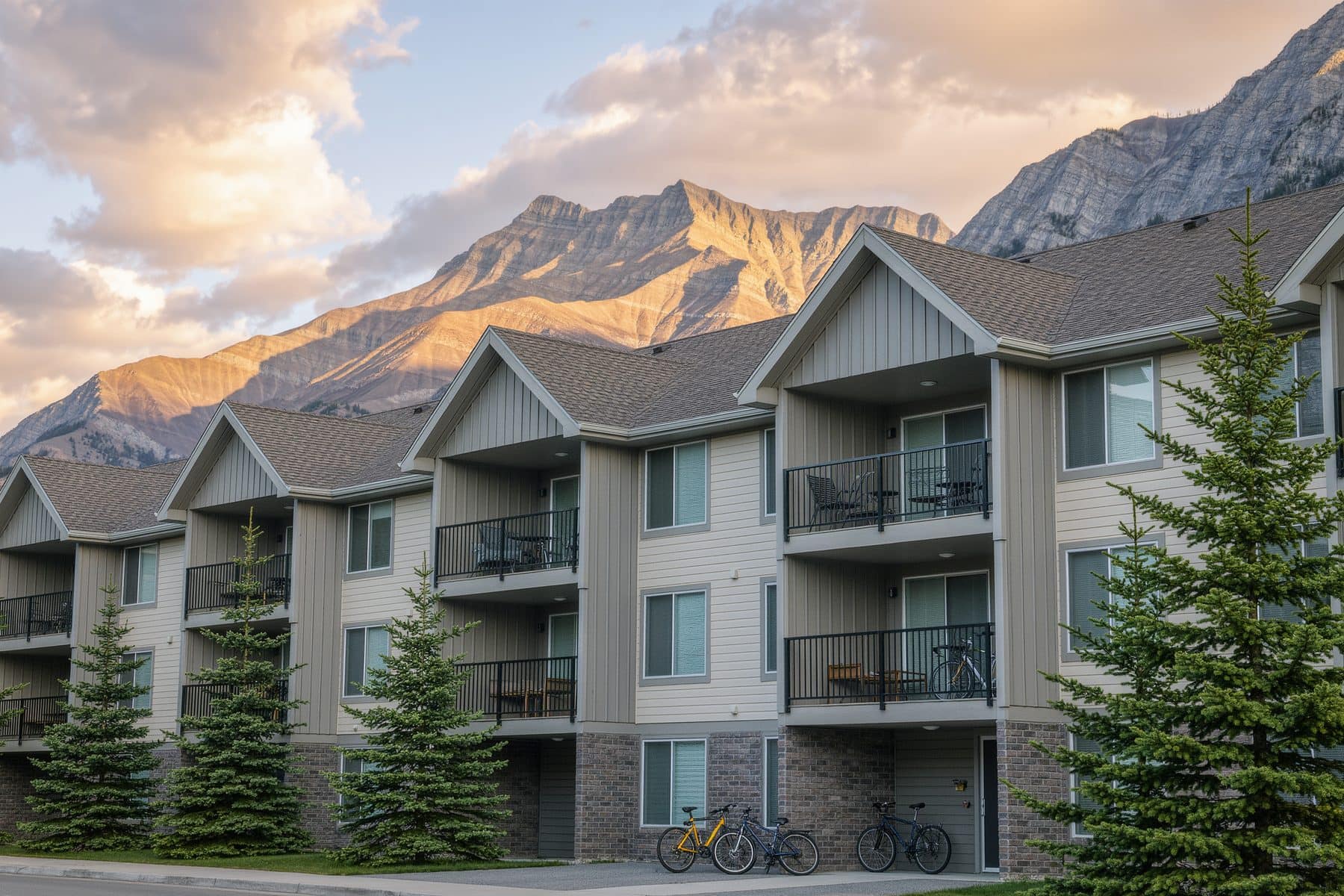
- Vacancy is about 0.9%, demand is not the constraint in this market, price is.
- A two-bedroom averaged $2,446 a month in 2025 (+7.8%); a one-bedroom averaged $1,880 (+13.0%).
- A long-term tenant staying 183 days including 60 consecutive days makes the property a primary residence for Livability Tax purposes.
- Residential zoning means no business licence, no tourist home tax rate and no nightly-rental management load.
- Gross yields are thin against Canmore prices. This is an appreciation and carrying-cost play, not a cash-flow one.
Canmore rental property investment is the quiet alternative to the tourist-home story, and for a lot of buyers it is the better one. You give up the headline revenue and get back the residential tax rate, a tenant who cuts their own grass, and, if you are an out-of-province owner, an exemption from the Livability Tax. The catch is that Canmore prices were set by second-home buyers, not by rent multiples, so the yield maths is unforgiving. Here is what the market actually pays.
Demand is not the problem for a Canmore rental property investment
Canmore's rental vacancy rate is about 0.9%. The Town also reports that roughly 25% of local homes lack a permanent resident, and that Canmore needs an estimated 3,400 below-market homes by 2041. Median assessed values sit at about $1.48 million for single-detached homes and $800,000 for condos.
Put together, that is a market where a well-priced rental unit lets quickly and stays let. What it is not is a market where the rent covers the mortgage.
- Two-bedroom average rent, 2025
- $2,446 / mo
- +7.83% vs 2024 (Alberta Regional Dashboard)
- One-bedroom average rent, 2025
- $1,880 / mo
- +13.0%: the fastest-rising segment
- Rental vacancy rate
- ≈ 0.9%
- Town of Canmore housing action material
Canmore Community Housing's tracking of advertised asking rents ran higher for larger units in 2025: around $3,211 for a two-bedroom and $4,122 for a three-bedroom, but those are asking prices on listings rather than achieved rents across the whole stock, and the two-bedroom figure actually fell year over year. Use the Alberta Regional Dashboard numbers for underwriting and treat asking rents as an upper bound. Advertised listing volume did rise notably in the second half of 2025, from 286 listings in 2024 to 365 in 2025.
The tax advantage nobody mentions
This is the strongest argument for long-term rental in Canmore, and it is structural rather than market-driven.
| Scenario | 2026 total tax rate | On a $900,000 assessment |
|---|---|---|
| Rented long-term to a primary resident | 0.457% | $4,109 |
| Second home, no Alberta resident on title | 0.833% | $7,501 |
| Tourist home (nightly rental) | 0.832% | $7,486 |
A tenant who lives in the property as their primary residence for at least 183 days in the year, including 60 consecutive days, makes it occupied for Livability Tax purposes. That holds no matter where the owner lives. For an Ontario or B.C. owner, putting a tenant in the property is worth roughly $3,400 a year on a $900,000 condo before a dollar of rent is counted. The Livability Tax guide sets out the test and the December declaration.
Filing the primary residence declaration by 31 December is the owner's job, every year, even when a tenant is in place. Miss it and the property is taxed at the higher rate for the year and you lose the right to complain about your assessment. As of April 2026, 566 Canmore properties still had not declared at all. Put it in the calendar the day you take possession.
What the yield actually looks like
Take a $750,000 two-bedroom condo rented at the 2025 average:
- Gross rent: $2,446 × 12 = $29,352
- Property tax at the primary residential rate: −$3,424
- Condo fees at $550 a month: −$6,600
- Insurance, maintenance, vacancy allowance at 5%: −$4,000
That leaves roughly $15,300 net operating income, or a gross yield of 3.9% and a cap rate near 2.0% before financing. At current mortgage rates the property will not cash-flow with a conventional 20% down payment. It will be close to break-even at a much larger down payment, and it will cover its own tax, fees and maintenance while someone else lives there.
That is the honest pitch for Canmore long-term rental: it is a way to hold an appreciating asset in a supply-constrained mountain town at low carrying cost, not a source of monthly income. The appreciation half of that argument is set out in the case for and against buying here. If cash flow is the objective, this is the wrong market. A point made in more detail in why the 2% rule does not work here.
- Vacancy near 0.9%: units let quickly and stay let
- Residential tax rate rather than the non-residential tourist home rate
- A resident tenant exempts the property from the Livability Tax whatever the owner's residency
- No business licence, no furnishing budget, no nightly management fee, no guest turnover
- Broadest possible buyer pool on resale. Every Canmore buyer can purchase residential
- Gross yields near 4% against Canmore prices; cap rates around 2%
- Will not cash-flow at conventional leverage at current rates
- Rents rose fast recently but advertised listing volume is rising too
- Alberta tenancy rules apply: tenant selection and notice periods matter
- No option to capture peak-season nightly rates unless the property is tourist-home zoned
Canmore's tenant demand comes from a workforce serving the visitor economy in a town with the highest living wage in Alberta at $38.80 an hour (2023, the last year Canmore participated). Employer-referred tenants, seasonal staff housing arrangements and long-standing local renters are the segment that fills a unit in days rather than weeks. Furnishing to a professional standard and pricing slightly under the top of the advertised range typically produces a longer tenancy, which is worth more than the extra $100 a month.
The purpose-built option
If you are building rather than buying, the Town's Purpose-Built Rental Incentive Policy grants the equivalent of 75% of municipal property taxes for up to 10 years. The conditions: at least 95% of units rented long-term to primary Canmore residents, a minimum of three units, minimum construction value of $300,000, and annual compliance reporting within 30 days of year-end. That is a meaningful subsidy for a small multi-unit project and one of the few places the Town's policy actively favours rental property investment.
What this means if you're buying
Buy long-term rental in Canmore for the carrying cost and the asset, not for the cash flow. Model the residential tax rate, real condo fees and a modest vacancy allowance, and check whether you can fund the shortfall comfortably for a decade, because that is the holding period this strategy needs. If you are an out-of-province buyer who wants a second home you can occasionally use, understand that occasional use and a 183-day tenant are mutually exclusive, and the tax difference between them is real money. Run the carrying costs through the buyer cost calculator and browse investment properties with the yield expectations set honestly.
Set a Canmore rental property investment beside the nightly-rental alternative in the Canmore tourist home overview, which covers the zoning, the tax class and the returns side by side.
Fifteen minutes with a local REALTOR® on realistic rents by building, tenant demand and what the numbers do at your down payment. Free, no obligation.
Frequently asked
What is the rental vacancy rate in Canmore?
About 0.9% according to the Town's housing action material. That is effectively full occupancy. A landlord's problem in Canmore is rarely finding a tenant. The Town also reports that roughly 25% of Canmore homes lack a permanent resident, which is what the Livability Tax was designed to address.
How much is rent in Canmore?
The Alberta Regional Dashboard reported a 2025 average of $2,446 a month for a two-bedroom, up 7.83% from $2,269 in 2024, and $1,880 for a one-bedroom, up 13.0%. Advertised asking rents tracked by Canmore Community Housing ran higher again for larger units.
Does renting long-term avoid the Canmore Livability Tax?
Yes, if the tenant lives there as their primary residence for at least 183 days in the year including 60 consecutive days. That makes the property occupied for the purposes of the program regardless of where the owner lives. The declaration still has to be filed by 31 December each year.
Is long-term rental better than short-term in Canmore?
It yields less gross and keeps far more of it. A two-bedroom grosses around $29,000 a year long-term versus $65,000 to $95,000 short-term, but short-term carries 25% to 30% management, cleaning, furnishing, a business licence and the non-residential tax rate, and requires tourist-home zoning you probably paid a premium for.
Are there incentives for building rental housing in Canmore?
Yes. The Town's Purpose-Built Rental Incentive Policy offers grants equivalent to 75% of municipal property taxes for up to 10 years, where at least 95% of units are rented long-term to primary Canmore residents, the project has a minimum of three units and a construction value of at least $300,000, with annual compliance reporting.
Keep reading

Tell us what you’re looking for and get a straight answer, usually the same day. Free, and no obligation.