Canmore Crossing
Canmore Crossing is a tourist-home complex on Railway Avenue, two blocks from Main Street. Most units can be rented nightly and also lived in full time.
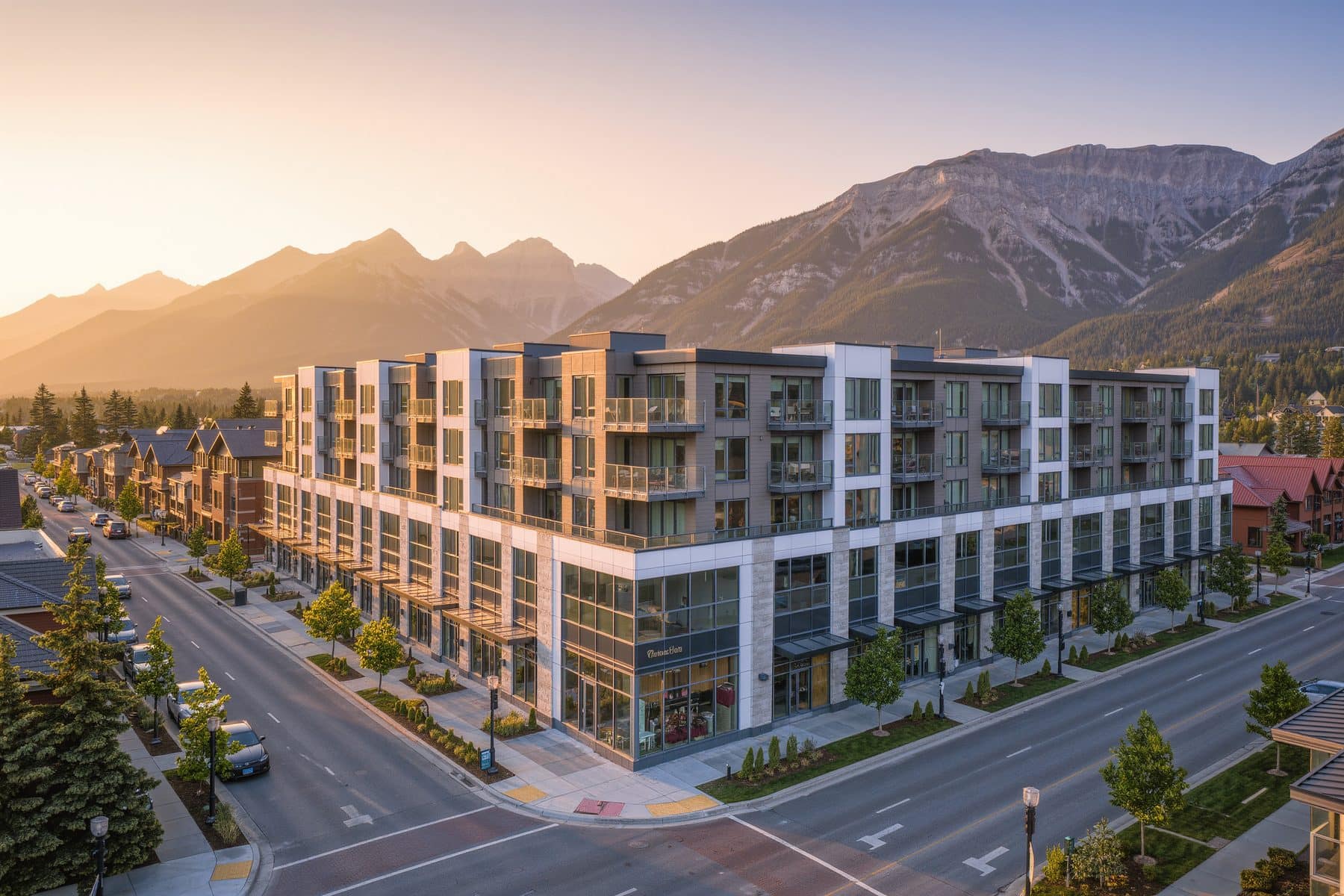
- Canmore Crossing is tourist-home stock, not visitor accommodation, which means a unit can be both a nightly rental and a home.
- The 2025 roll shows 32 tourist homes at 1160 Railway Avenue, 26 at 1120 and 21 at 1140, plus a handful of residential titles across the same block.
- Tourist homes are taxed at 0.832% of assessed value all in for 2026, below the 0.957% hotel-condo rate and above the 0.457% primary-residential rate.
- Since 11 March 2025 new tourist-home use is permitted only in Silvertip’s STR districts and Three Sisters Village, so downtown stock like this cannot be replaced.
- A Town of Canmore business licence is required per unit, with the number shown in all advertising, and the condominium bylaws can still restrict what the zoning allows.
Canmore Crossing is the complex people find when they want nightly-rental income without living beside the highway. It sits on Railway Avenue in the town centre, roughly two blocks from Main Street, and on the Town of Canmore's 2025 assessment roll the buildings there are dominated by Tourist Home titles rather than hotel-condo ones. That single distinction changes what you can do with a unit: a tourist home can be rented to guests, rented long term, or lived in by its owner.
What Canmore Crossing is and what the roll shows
The complex is a low-rise, mixed-use development on the block of Railway Avenue running from 1120 to 1160. Its own booking contact gives 1160 Railway Avenue as the address, and 1120 Railway Avenue is also marketed as Canmore Crossing. The three condominium plans registered on that block date to 2002, 2003 and 2004, which is consistent with a staged build across the early 2000s. Ground-floor commercial space sits under the residential floors, and the shops and supermarkets of the town centre are on the doorstep.
| Address | Tourist Home titles | Residential titles | Plan year |
|---|---|---|---|
| 1120 Railway Avenue | 26 | 2 | 2002 |
| 1140 Railway Avenue | 21 | 3 | 2003 |
| 1160 Railway Avenue | 32 | 2 | 2004 |
Separately titled parking stalls make up most of the remaining parcels, along with a handful of non-residential commercial titles. We have confirmed the Canmore Crossing name against 1160 and 1120 Railway Avenue; 1140 sits between them on the same block with the same profile, but we have not confirmed that it carries the same name, so treat that row as neighbouring stock unless the title says otherwise.
Is nightly rental permitted at Canmore Crossing
For the tourist-home units, yes. A tourist home is defined by the Town as "a dwelling unit operated as a temporary place to stay, with or without compensation," and it requires a development permit plus one business licence per unit, with the licence number shown in all advertising. For the small number of residential titles in the same buildings, no: the Town states plainly that residential dwelling units may not be promoted on short-term listing sites, and enforces with fines of $2,500 and then $5,000.
The wider context matters here. On 11 March 2025 Council removed tourist home as a permitted use from the established residential districts. It remains permitted only in Silvertip’s STR-1 and STR-2 districts and on the Three Sisters Village parcels identified in that plan, so no new tourist homes can be created downtown or in any other established neighbourhood. Existing ones continue, and a streamlined change of use lets owners convert a tourist home to residential, with the fee waived until 31 December 2026. That conversion runs one way only and is irreversible. Around 40 properties had converted as of January 2026, which means the pool in the established neighbourhoods is not just capped, it is slowly shrinking, while new supply is concentrated in Three Sisters Village.
A tourist-home designation tells you what the Town allows. It does not tell you what the corporation allows. Condominium bylaws can restrict or prohibit short-term rental in a building the Land Use Bylaw permits it in, and in a mixed complex with full-time residents living alongside nightly guests, that pressure is real. Read the bylaws and the last two years of minutes before you assume a unit can be operated the way the listing describes.
What it costs to own at Canmore Crossing
Property tax follows the class. A tourist home is taxed at 0.832% of assessed value all in for 2026: the non-residential municipal rate, plus the residential education rate, the seniors requisition and the Vital Homes levy. That is about 1.8 times what a primary residence pays all in, and slightly below the 0.957% a hotel condo pays. The municipal portion alone is roughly three times the primary-residential municipal rate, which is where the widely repeated "three times the tax" claim comes from, and why it is misleading without the qualifier. Work through the Canmore property tax page before modelling.
One point catches owners out. The Tourist Home Personal Use subclass was removed in November 2024, so a tourist home you live in yourself is taxed identically to one running at 70% occupancy. If your plan is mostly personal use with a few rented weeks, you are paying a commercial-leaning tax rate for the privilege.
Condo fees we will not guess at. What is knowable is the shape: a mixed-use building with commercial space below, elevators, underground parking and a mix of residents and guests. Ask for the estoppel certificate, the budget, the reserve fund study and the minutes. Alberta caps the estoppel certificate fee at $200, or $300 rushed, and the corporation must respond within 10 days, so there is no reason to skip it. Our what the monthly fee actually covers covers what a healthy set of documents looks like.
Then the revenue costs: a management share if you use one, the Alberta tourism levy at 6% for bookings after 31 March 2026, GST, cleaning and platform fees. Put them all through the tourist home ROI calculator.
The nightly-rental case for a town-centre tourist home is different from the case for a highway-corridor hotel condo. Guests who can walk to Main Street, the supermarkets and the river trail will pay for that, and they book shoulder seasons more reliably than guests who need a car for everything. When you compare this complex against Kananaskis Way, compare occupancy in April and November, not just the July rate. That is where a central location earns its premium.
Tourist home or hotel condo: which product Canmore Crossing actually is
The two nightly-rental products in this town are not variations on a theme. They are different assets with different buyers, and the Crossing sits squarely on one side of the line.
| Tourist home, as at the Crossing | Visitor accommodation, as on Kananaskis Way | |
|---|---|---|
| Nightly rental | Yes, with a business licence | Yes, with a business licence |
| Live there full time | Yes | No, guest stays capped at 30 days |
| Long-term tenancy | Yes | No |
| 2026 tax rate, all in | 0.832% | 0.957% |
| Livability Tax exposure | Already in the higher class | Already in the higher class |
| Supply | Capped in the established neighbourhoods since March 2025 and shrinking through conversions; new supply only in Three Sisters Village and Silvertip | Still growing, with 800-plus new units expected in three to four years |
That last row is the one investors underweight. Tourist-home supply cannot grow, while visitor-accommodation supply is still being approved along the highway corridor. Two assets that look similar on a spreadsheet are pointing in opposite directions on supply.
What the assessed values say about the Crossing
On the 2025 roll, dwelling assessments ran from roughly $715,000 to $947,000 at 1160 Railway Avenue, $819,000 to $1,022,000 at 1140, and $814,000 to $1,185,000 at 1120. Those are tight bands by Canmore standards, which suggests a fairly consistent unit product rather than a mix of studios and penthouses.
Two things follow. Comparable sales inside the complex are genuinely comparable, which helps when you are testing an asking price. And because the tax bill is a straight percentage of the individual assessment, the annual holding cost across these units is fairly predictable: at 0.832%, a $900,000 assessment produces roughly $7,490 a year before condo fees, insurance or management.
Who a Canmore Crossing unit suits, and who it does not
It suits the buyer who wants optionality: nightly income now, a long-term tenancy if the market turns, and the right to move in without breaking any rule. That flexibility is exactly what a hotel condo cannot offer, and it is why tourist-zoned stock in Canmore has historically traded at a premium of roughly 20% to 30% over comparable residential.
It does not suit a buyer expecting residential tax treatment, or one who wants a purely passive holding, since a mixed complex with full-time neighbours takes more management judgement than a building where every unit is a hotel suite. And financing is tighter than for a home: rented, non-owner-occupied property cannot be CMHC insured, so lenders commonly want 25% to 35% down. See financing a short-term rental in Canmore.
What this means if you are buying at Canmore Crossing
Canmore Crossing is one of the few central addresses in town where the tourist-home right still sits on a walkable block rather than on the highway. Before you offer, get the assessment class on the specific unit in writing, the development permit that created the designation, the current business licence status, the condominium bylaws and minutes, and the full financial package. Underwrite at 0.832% property tax, a real management share and a real cleaning cost. Then compare the result against a hotel condo on Kananaskis Way and against the rest of the how the buildings compare, because the two products behave very differently in a soft season.
Send us the unit number and we will confirm the assessment class, the permit and the licence status with the Town before you write. Free, no obligation.
For the wider picture, see Canmore condos for sale: prices by building, condo fees and what each tax class means.
Frequently asked
Can Canmore Crossing units be rented nightly?
Most can. The 2025 assessment roll shows the Railway Avenue buildings dominated by Tourist Home titles, which may be rented nightly with a Town business licence. A small number of residential titles sit in the same buildings and may not be rented nightly at all. Confirm the class on the specific unit, and read our tourist home zoning guide first.
Can I live at Canmore Crossing full time?
In a tourist-home unit, yes. That is the main difference between this complex and the hotel condos on Kananaskis Way. A tourist home is a dwelling unit that can be lived in, rented long term or rented nightly, while visitor accommodation is capped at 30-day guest stays and cannot be a residence.
What tax rate applies at Canmore Crossing?
The tourist-home rate, 0.832% of assessed value all in for 2026, made up of the non-residential municipal rate plus the residential education rate, the seniors requisition and the Vital Homes levy. That is about 1.8 times what a primary residence pays all in. The Canmore property tax page sets out the arithmetic.
Does living in a tourist home change the tax?
No. The Town removed the Tourist Home Personal Use subclass in November 2024, so every tourist home is taxed at the same rate whether it is rented nightly or occupied by its owner. That is a real cost to weigh if you plan mostly personal use. See Canmore tourist home tax for the detail.
How central is Canmore Crossing?
It is on Railway Avenue in the town centre, roughly two blocks from Main Street and within a short walk of both major supermarkets and the Bow River trail system. That walkability is the main thing separating it from the Bow Valley Trail hotel corridor, where most of the town's nightly-rental stock sits.
- Town of Canmore: 2025 Assessment Roll by Tax Roll (effective February 18, 2025)
- Town of Canmore: Tourist Homes (class 21, business licence per unit, March 2025 bylaw change)
- Town of Canmore: Accommodation Types (visitor accommodation, tourist home, residential)
- Town of Canmore: 2026 tax rates by property class
- Rentals in the Rockies: Canmore Crossing, 1160 Railway Avenue, Canmore
Keep reading

Tell us what you’re looking for and get a straight answer, usually the same day. Free, and no obligation.
Nightly rate, occupancy, management fees, tourist-home tax and financing, cash flow, cap rate and break-even in one place.
Tourist-home ROI calculator